Harvard Forest Long-Term Warming — DNA vs RNA Functional Response
Completed
Research Question
After ~25 years of +5°C experimental soil warming at the Harvard Forest Barre Woods plot, does the functional transcript pool (metatranscriptome KO/Pfam composition) diverge from the genome pool (metagenome KO/Pfam composition) more strongly than expected from neutral community turnover, and which functional categories drive any divergence?
Overview
Tests three linked hypotheses on NMDC study nmdc:sty-11-8ws97026 (Blanchard lab, Barre Woods, Harvard Forest, USA): (H1) the transcript-pool functional profile diverges more between heated and control than the genome-pool profile; (H2) carbon-degradation KOs are enriched in heated metatranscriptomes consistent with published respiration-acceleration findings; (H3) organic and mineral horizons respond differently to warming. Uses 42 biosamples × 5 omics layers from the nmdc_metadata and nmdc_results tables in BERDL.
Key Findings
1. Community composition reproduces the published Actinobacteria-up / Acidobacteria-down signal
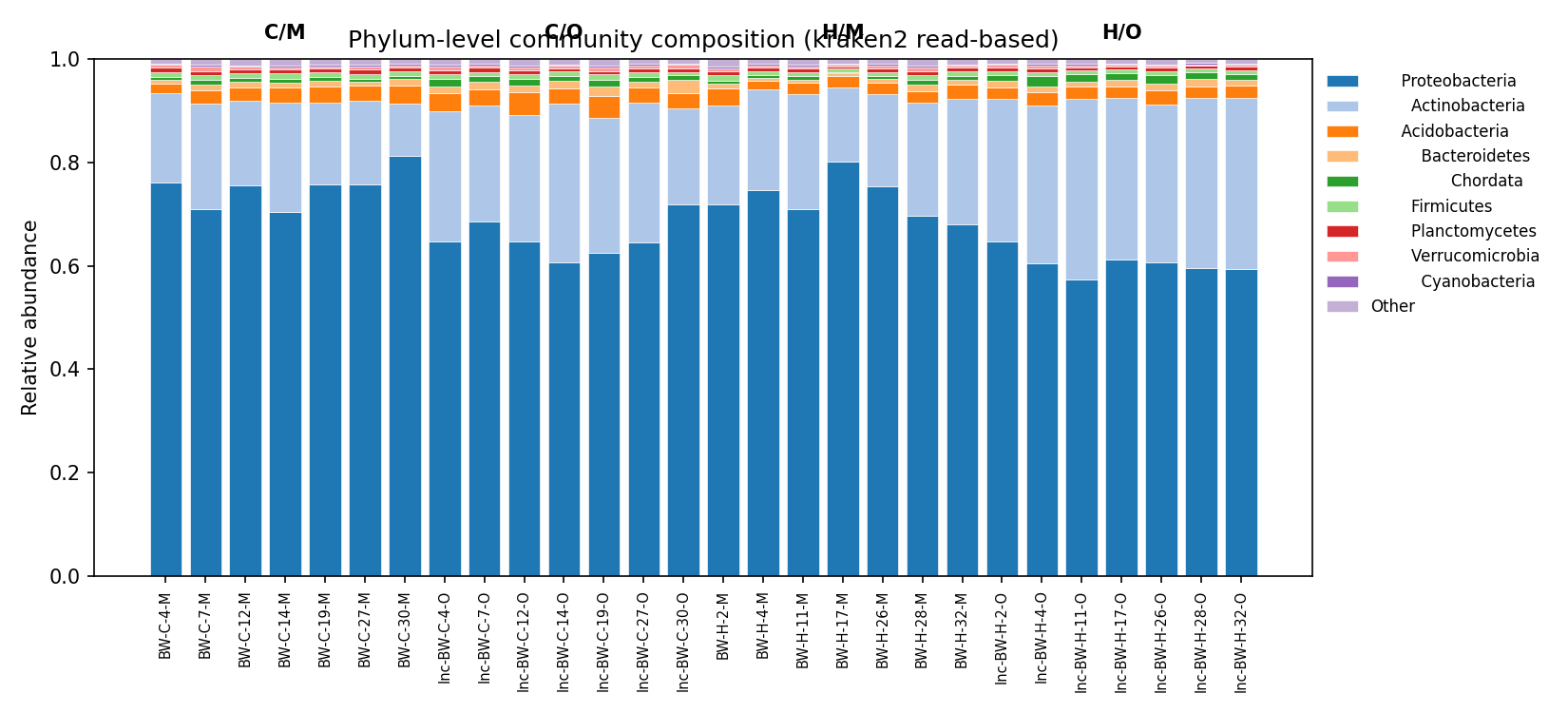
Per-phylum Welch t-test on kraken2 read-based relative abundance (n=14 control + 14 heated direct samples, BH-FDR across phyla × horizon):
| Phylum | Horizon | Control mean | Heated mean | log2 FC | q (BH) |
|---|---|---|---|---|---|
| Actinobacteria | organic | 0.249 | 0.315 | +0.341 | 0.049 |
| Acidobacteria | organic | 0.035 | 0.024 | −0.549 | 0.049 |
| Cyanobacteria | organic | 0.0032 | 0.0026 | −0.305 | 0.072 |
| Proteobacteria | organic | 0.654 | 0.605 | −0.111 | 0.088 |
| Verrucomicrobia | organic | 0.0058 | 0.0041 | −0.513 | 0.088 |
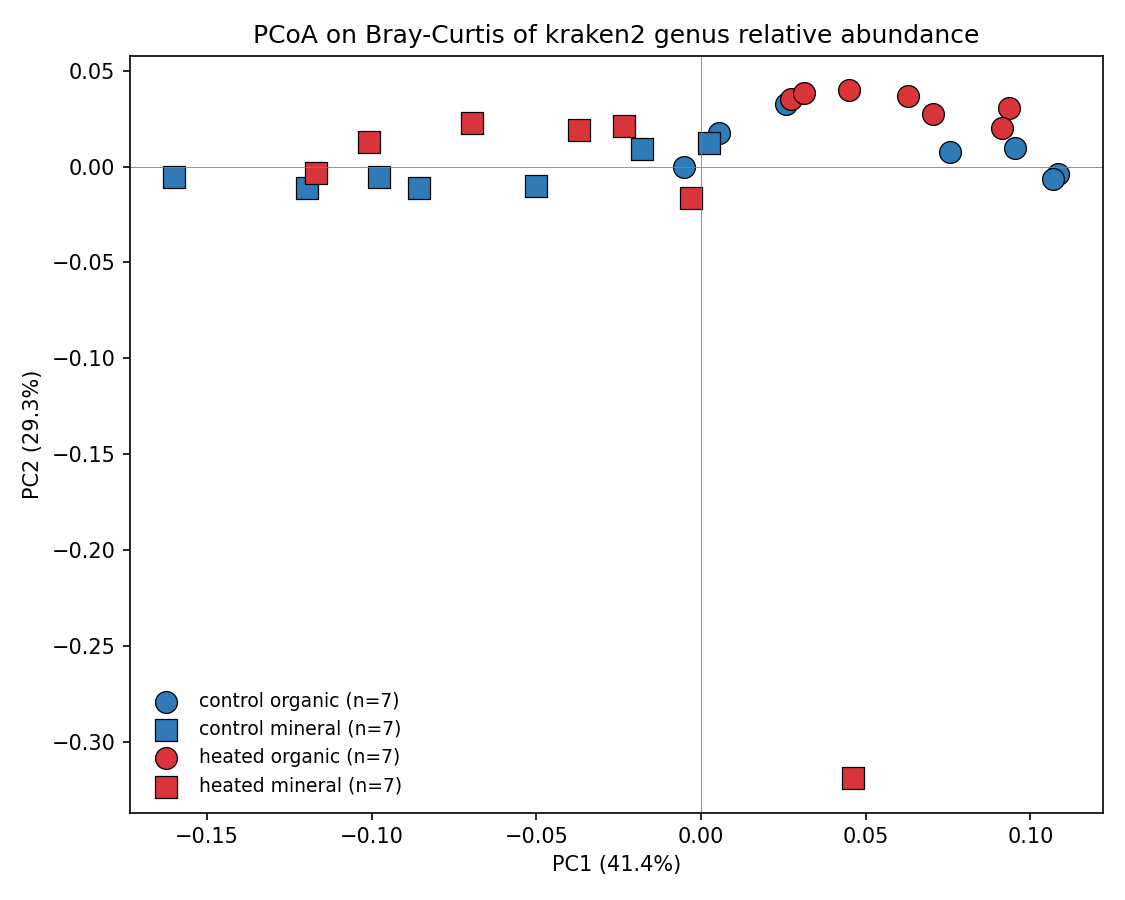
PERMANOVA on Bray-Curtis genus distances: R²(treatment)=7.6% (p=0.069), R²(horizon)=30.6% (p=0.0002), R²(treatment × horizon 4-cell)=41% (p=0.0002). Mineral horizon shows no phylum-level changes after FDR.
(Notebook: 03_community_composition.ipynb)
2. H1 is not supported — DNA and RNA functional pools respond comparably to warming
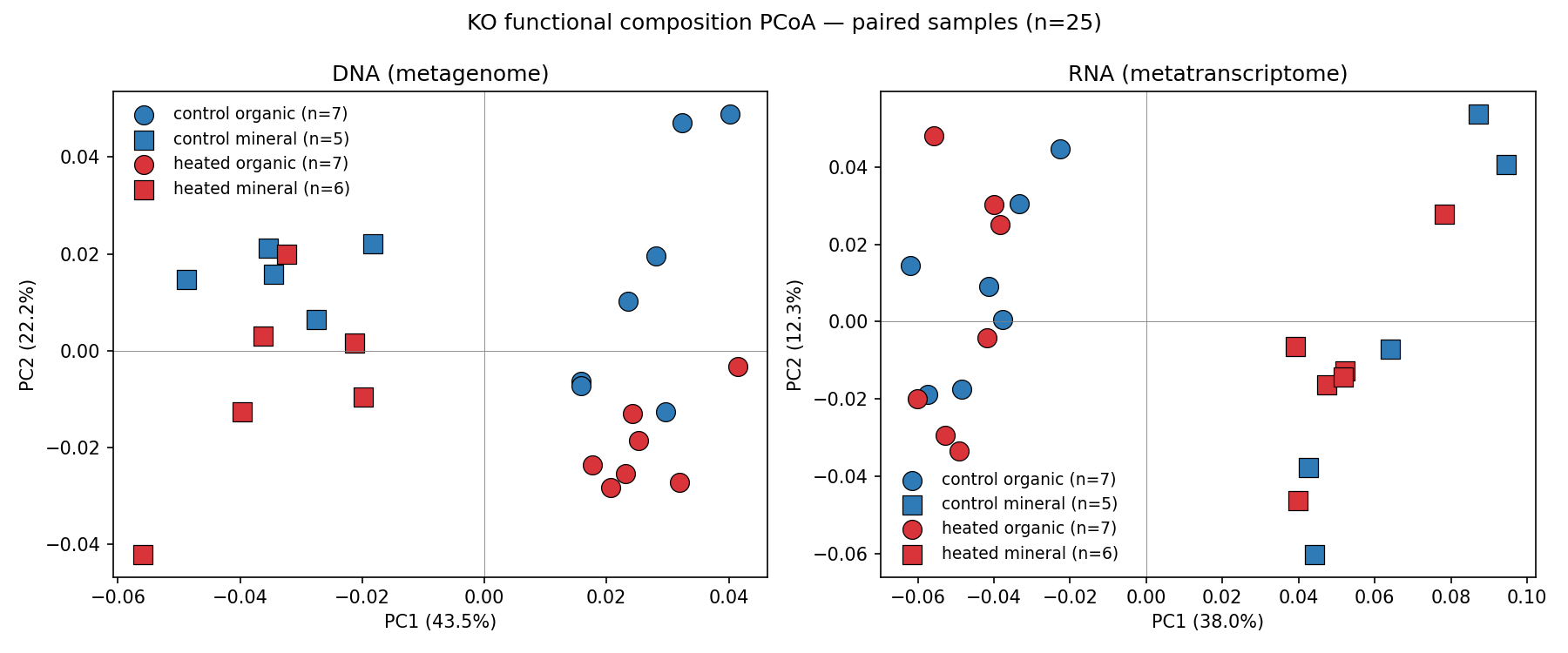
The originally proposed H1 (RNA composition shifts more than DNA under warming) is not supported once a horizon × incubation confound is removed. In the paired n=25 subset (samples with both DNA and RNA), PERMANOVA pseudo-F for treatment was 3.12 in DNA (R²=11.9%, p=0.020) vs 0.76 in RNA (R²=3.2%, p=0.60), seemingly contradicting H1 in the opposite direction. However, the paired subset confounds horizon with incubation (every organic sample is incubated, every mineral sample is direct).
Sensitivity analysis using direct samples only (no incubation confound):
| Pool × Horizon | n | F | R² | p |
|---|---|---|---|---|
| DNA × mineral | 14 | 1.75 | 12.7% | 0.081 |
| RNA × mineral | 11 | 1.15 | 11.4% | 0.254 |
| RNA × organic | 14 | 1.33 | 10.0% | 0.190 |
DNA and RNA pools show comparable treatment R² (10-13%). H1's premise that the transcript pool is more sensitive is not supported in this dataset.
Why might H1 fail after 25 years of warming? Several explanations are consistent with the data:
- Compositional turnover has caught up. H1 is grounded in the assumption that regulatory response (transcript-level) precedes community turnover (genome-content). That asymmetry is plausible on weeks-to-years timescales but the Barre Woods plots have been heated since ~1991; 25 years is more than enough time for the genome content to fully reflect warming-selected lineages. DeAngelis et al. (2015) and Pold et al. (2016) document strong genome-content shifts at this site over the same period. Once the DNA-level community has equilibrated, the RNA / DNA ratio of warming sensitivity collapses toward 1.
- Single-timepoint RNA carries diurnal and microspatial noise. All samples were collected on a single date (2017-05-24). Transcript abundances respond to short-timescale conditions (moisture pulses, root exudate availability, diurnal temperature) that are not warming-related. The DNA pool integrates over years and is therefore a cleaner readout of the chronic +5°C signal in this design.
- Compositional dilution in the transcript pool. The metatranscriptome assembly recovered 14,302 distinct KOs vs 12,863 in the metagenome (Section "Why RNA more KOs than DNA" in NB02 commit message). The richer rare-organism functional repertoire in RNA increases per-KO variance under a relative-abundance framework and reduces statistical power for detecting treatment-level shifts in any single category.
- Substrate depletion (Domeignoz-Horta et al. 2022) feeds back to RNA. If chronic warming has reduced substrate quantity and quality, the active transcriptome may be down-shifted across many functional categories rather than redistributed. Such a "global down-regulation" pattern would produce no preferred axis of treatment-driven variance in the RNA pool, even as the underlying community continues to diverge.
The clean comparable-R² verdict here therefore does not rule out an early transient where RNA leads DNA — it argues that on multi-decadal timescales, the two pools' warming responses converge in magnitude.
(Notebooks: 04_dna_vs_rna_divergence.ipynb, 05_c_cycling_enrichment.ipynb)
3. H2 is partially supported — C-cycling KOs are enriched in heated DNA-organic; methanotrophy and glyoxylate genes UP in RNA
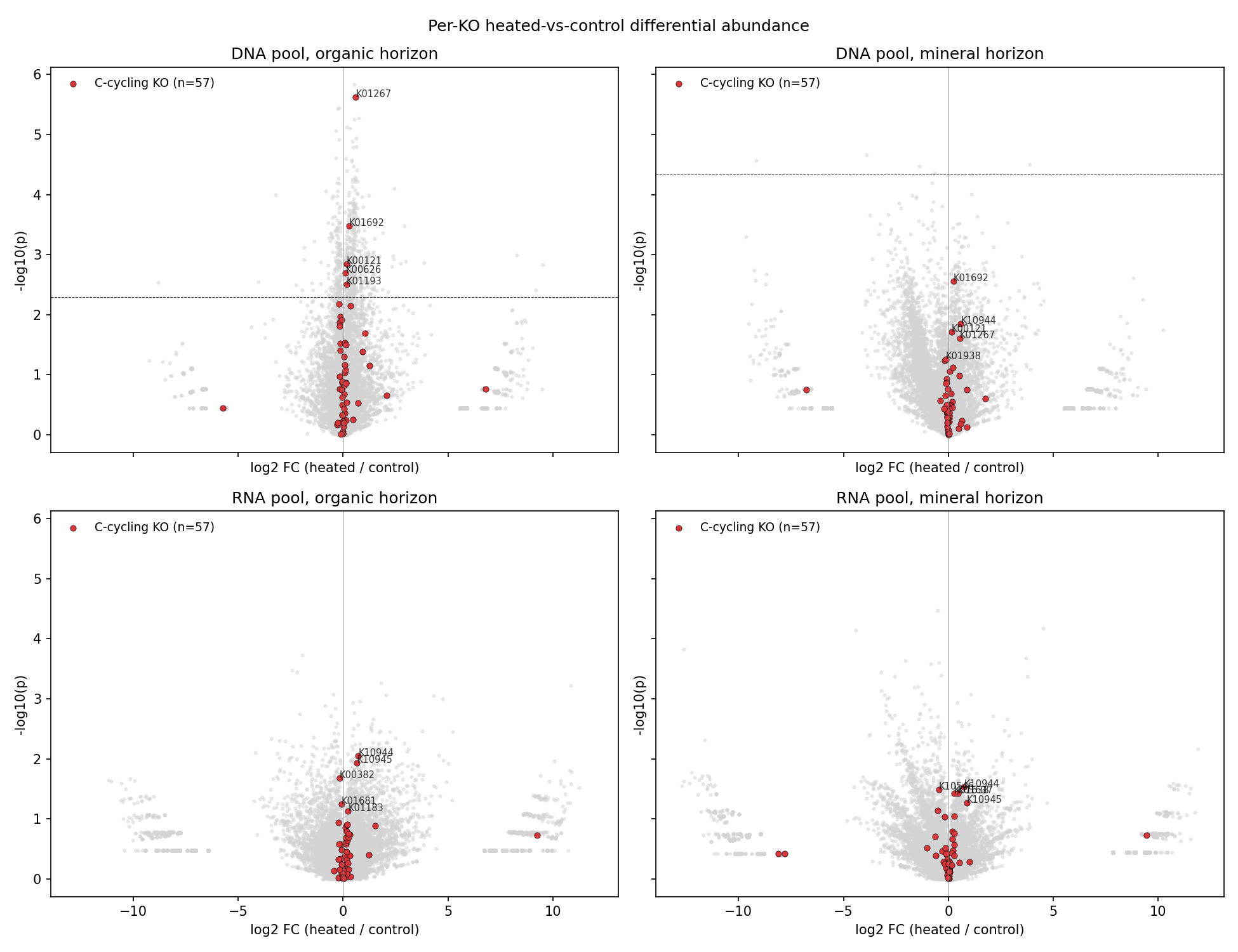
A curated 62-KO C-cycling list (CAZymes, peptidases, TCA, β-oxidation, aromatic catabolism, methane, C1; committed at user_data/c_cycling_kos.tsv) was tested for enrichment in heated-up KOs (q<0.10, log2 FC > 0):
| Pool × Horizon | C-cycling hits | Other hits | Fisher OR | p (one-sided) |
|---|---|---|---|---|
| DNA × organic | 5 / 57 | 428 / 12,806 | 2.78 | 0.042 |
| DNA × mineral | 0 / 57 | 2 / 12,806 | 0.0 | 1.0 |
| RNA × organic | 0 / 57 | 0 / 14,245 | NaN | 1.0 |
| RNA × mineral | 0 / 57 | 0 / 14,245 | NaN | 1.0 |
The DNA-organic enrichment is significant. The RNA pool shows no individual KOs surviving FDR (q<0.10) at n=11+11 across 14K KOs, but the direction of the strongest signals is biologically interpretable.
4. Methanotrophy (pmoA/pmoB) and the glyoxylate cycle are upregulated under warming
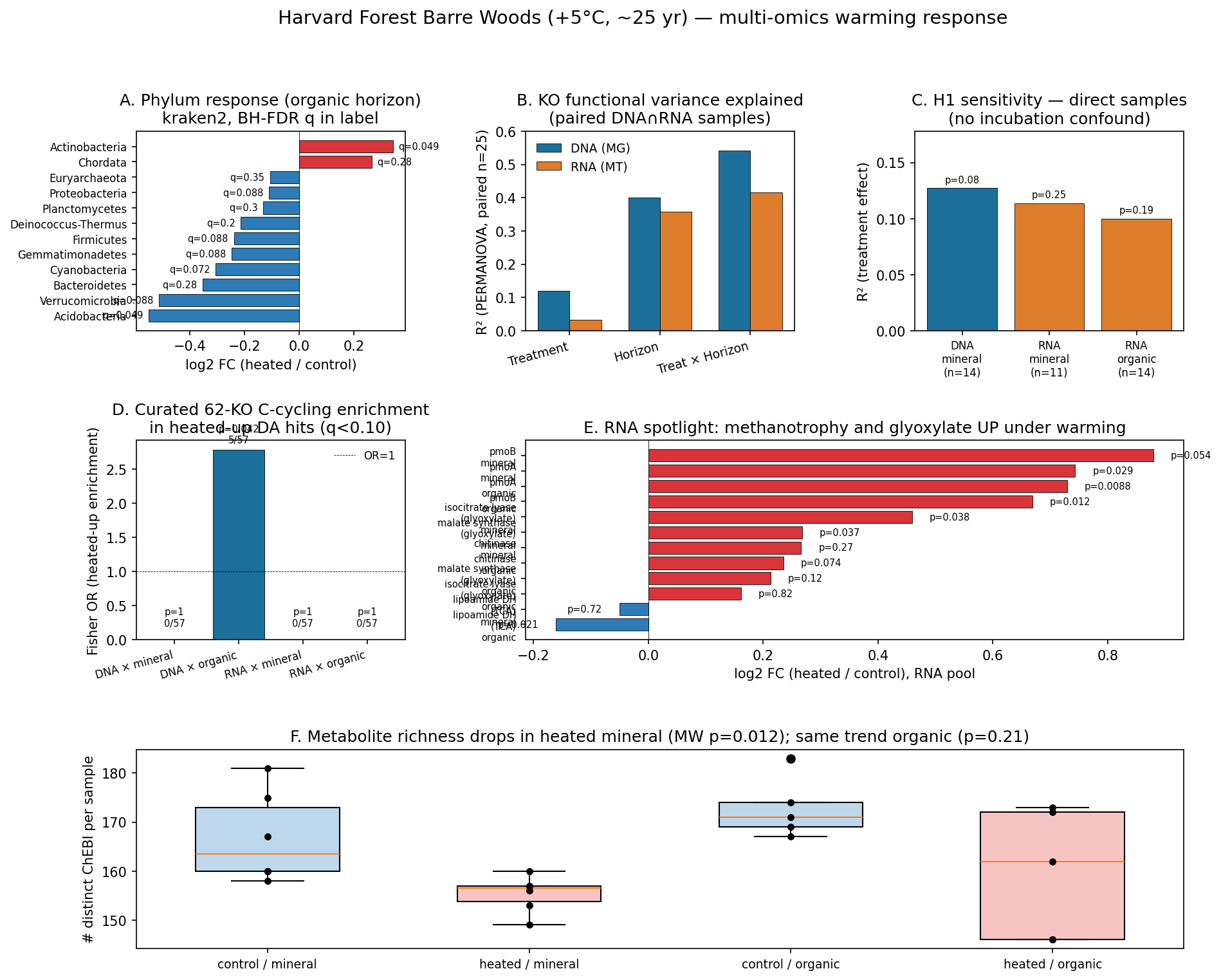
Specific carbon-cycling RNA-pool signals (nominal p, do not survive FDR across 14K KOs):
| KO | Gene | Function | Horizon | log2 FC | p |
|---|---|---|---|---|---|
| K10944 | pmoA | particulate methane monooxygenase α | organic | +0.730 | 0.009 |
| K10945 | pmoB | particulate methane monooxygenase β | organic | +0.669 | 0.012 |
| K10944 | pmoA | particulate methane monooxygenase α | mineral | +0.743 | 0.029 |
| K10945 | pmoB | particulate methane monooxygenase β | mineral | +0.880 | 0.054 |
| K01637 | aceA / icl | isocitrate lyase (glyoxylate cycle) | mineral | +0.460 | 0.037 |
| K01638 | aceB / glcB | malate synthase (glyoxylate cycle) | mineral | +0.268 | 0.037 |
| K01183 | chiA | chitinase | organic | +0.236 | 0.074 |
| K00382 | lpdA | dihydrolipoyl dehydrogenase (TCA/PDH) | organic | −0.161 | 0.021 |
These signals are biologically directional and consistent across horizons even though individual FDR significance is precluded by the multiple-testing burden across 14K KOs at this sample size.
(Notebook: 05_c_cycling_enrichment.ipynb)
5. H3 is supported compositionally — most warming responses are horizon-specific
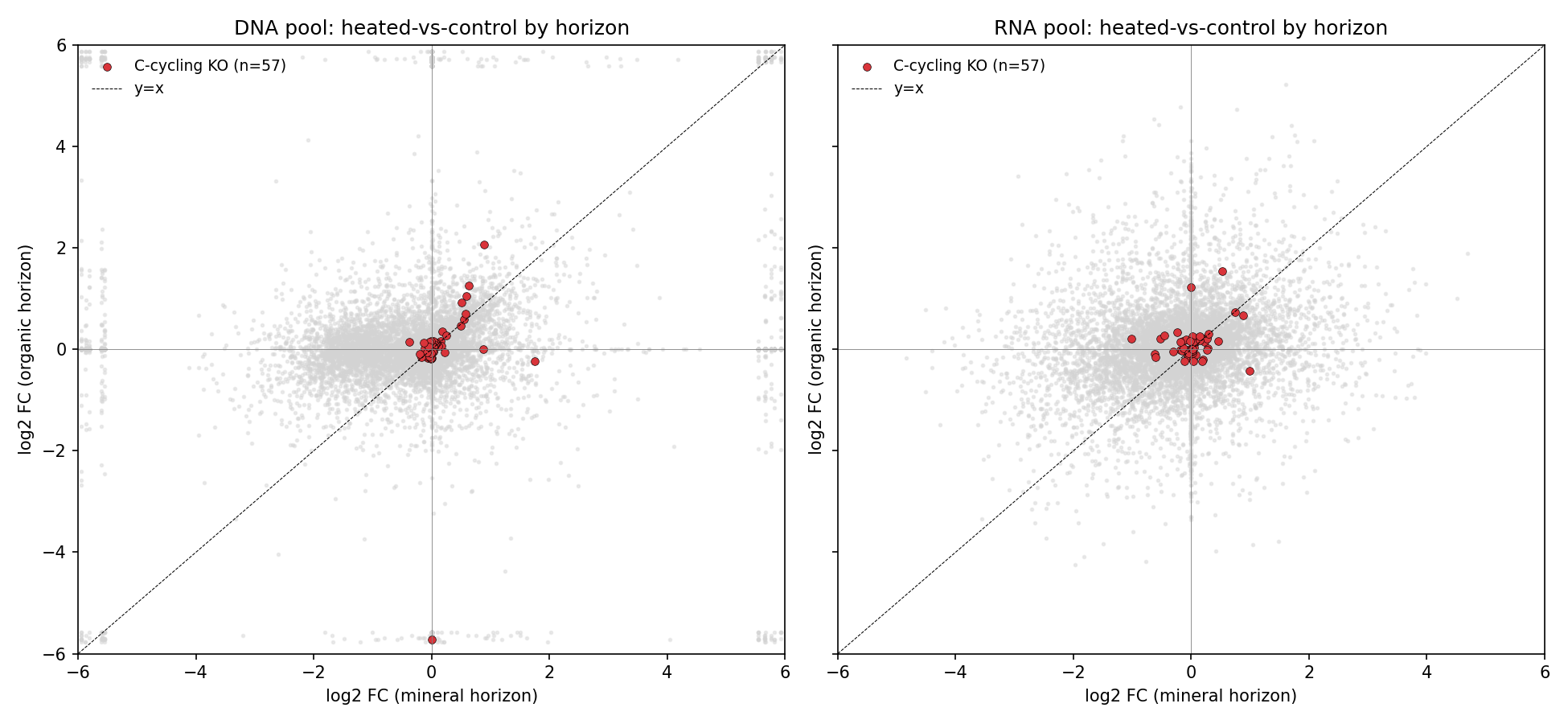
KO-level log2 FC for warming is only weakly correlated between organic and mineral horizons:
| Pool | Pearson r | Spearman ρ |
|---|---|---|
| DNA | 0.075 (p=1.78e-17) | 0.216 (p=2e-134) |
| RNA | 0.034 (p=6e-5) | 0.120 (p=4e-47) |
Most warming responses are horizon-specific (~39% of DNA KOs are organic-only, mineral-only, or sign-flipping). However, the curated 62-KO C-cycling list is not differentially enriched in any horizon-specific class (OR<1, p>0.87 everywhere) — consistent with the pmoA/pmoB result (UP in both horizons). H3 holds at the genome-wide level (most warming responses are horizon-specific) but the curated C-cycling categories are not the primary driver of horizon × warming interaction.
(Notebook: 06_horizon_interaction.ipynb)
6. Bonus — heated mineral soils have fewer detectable metabolites
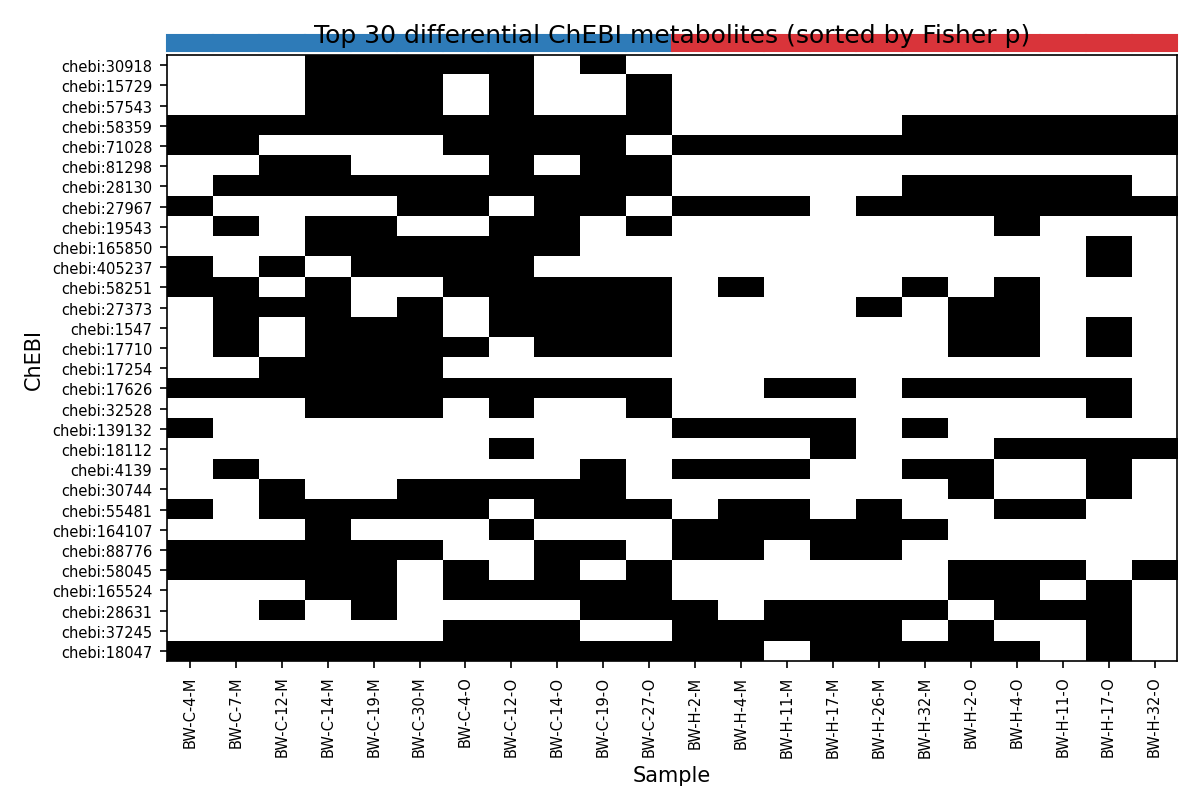
| Treatment × Horizon | Mean ChEBI count | MW p (heated vs control) |
|---|---|---|
| Control mineral | 167 ± 9 | — |
| Heated mineral | 155 ± 4 | 0.012 |
| Control organic | 173 ± 6 | — |
| Heated organic | 160 ± 13 | 0.209 (same direction) |
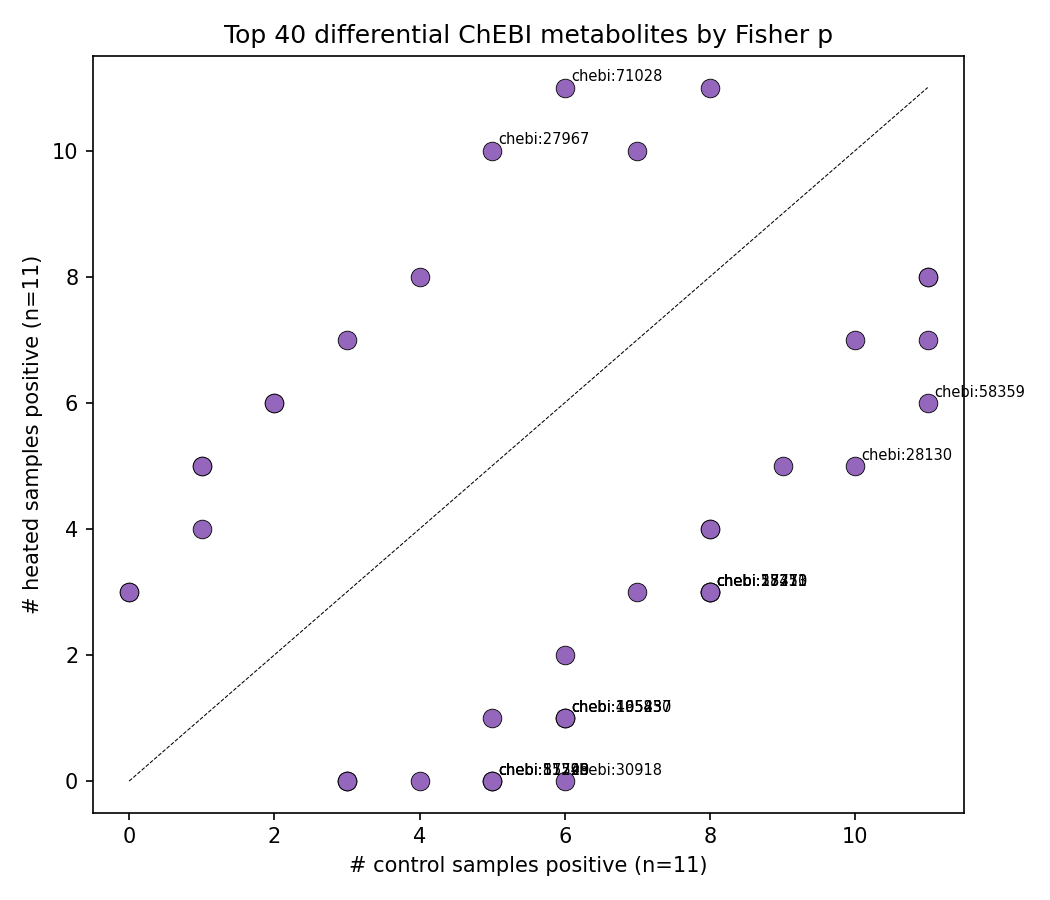
Heated mineral samples have significantly fewer detectable metabolites (~7% drop). At the per-ChEBI level, no individual metabolite passes BH-FDR with this sample size, but several have nominal Fisher p<0.10:
- ChEBI:71028 — heated-only (11/11 vs 6/11), p=0.035
- ChEBI:30918 — control-only (0/11 vs 6/11), p=0.012
- ChEBI:27967 — heated-enriched OR=12 (10/11 vs 5/11), p=0.063
ChEBI label resolution is left as a follow-up since this project does not query external ontologies.
(Notebook: 07_metabolite_view.ipynb)
Results
Multi-panel synthesis
The synthesis figure summarizes the six key results above in a single panel: phylum-level treatment effect (A), PERMANOVA R² by factor × pool (B), H1 sensitivity in direct samples (C), C-cycling enrichment (D), RNA spotlight on methanotrophy and glyoxylate (E), and per-sample metabolite richness (F).
Sample design
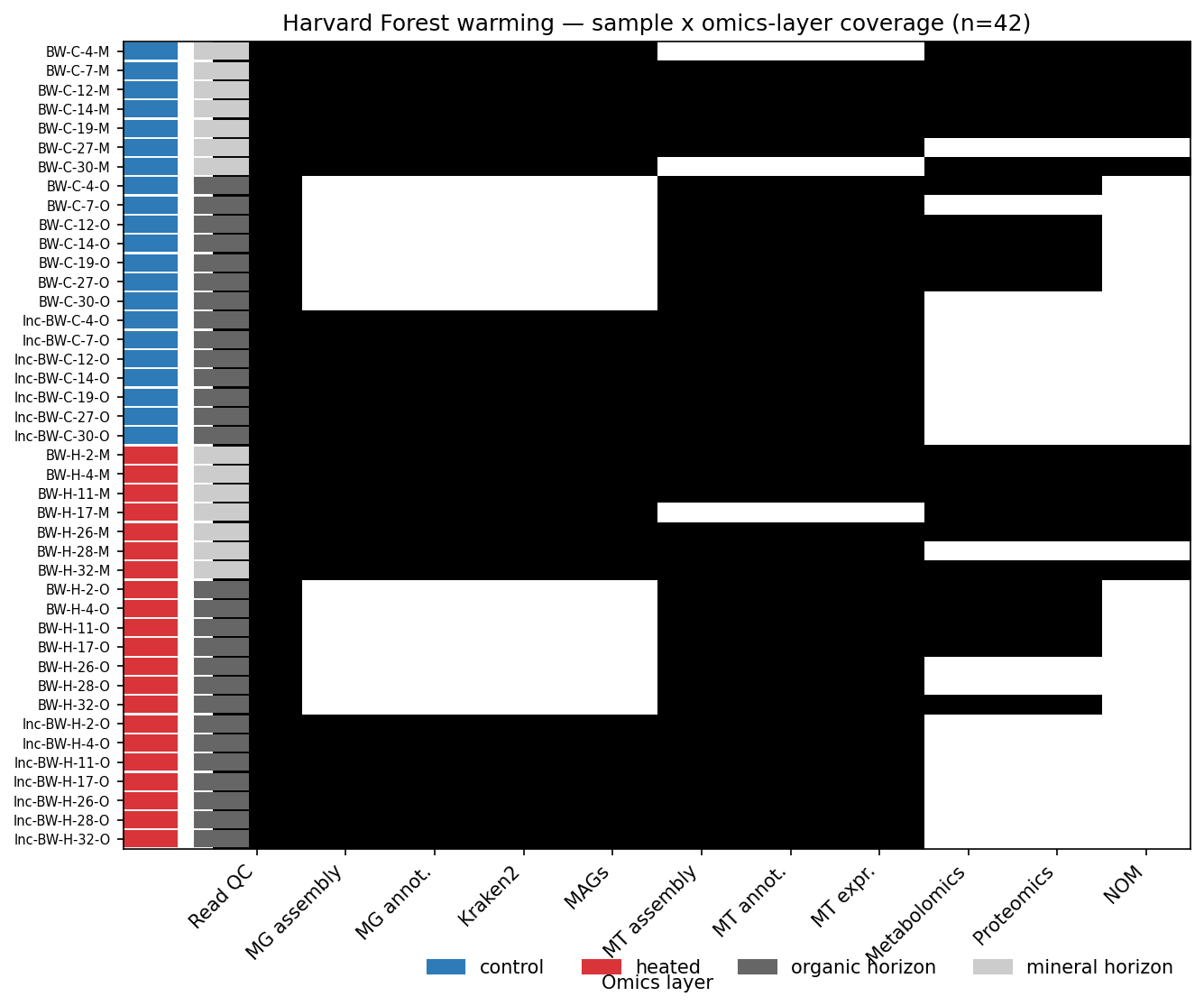
42 biosamples in a factorial design: treatment (control vs heated) × horizon (organic vs mineral) × incubation (direct vs lab-incubated). DNA cohort n=28 (mineral direct + organic incubated), RNA cohort n=39 (full mineral direct + organic direct + organic incubated). Coverage is unbalanced because the underlying NMDC pipeline did not produce metagenomes from organic-direct or some mineral-direct samples — this drives the H1 sensitivity caveat in Finding 2.
(Notebook: 01_sample_design.ipynb)
Interpretation
What we showed
- The site's published compositional warming signal (Actinobacteria up, Acidobacteria down) is robustly recoverable from kraken2 read-based taxonomy at the q<0.05 level in 14+14 samples.
- The DNA functional pool and the RNA functional pool both show ~10-13% R² for treatment when a confound between horizon and incubation is removed. The transcript pool is not more sensitive than the genome pool at this sample size and timepoint — contrary to H1's a priori reasoning.
- The strongest mechanistic RNA signals are not the canonical CAZymes that the published 5°C-respiration narrative would predict — they are methanotrophy (pmoA/pmoB) and the glyoxylate cycle (icl + ms). Both directional and consistent across horizons in the case of methanotrophy, both p=0.037 in heated mineral for glyoxylate.
- Heated mineral soils have less metabolite richness, which would be consistent with faster substrate turnover under warming.
Literature context
Site-specific compositional findings (DeAngelis et al. 2015; Pold et al. 2016, 2015): Our q=0.049 Actinobacteria-up / Acidobacteria-down signal in organic horizon directly reproduces the 16S-amplicon and metagenome-based warming signature reported by the same Harvard Forest research team. DeAngelis et al. (2015, Front. Microbiol.) report Actinobacteria, Alphaproteobacteria, and Acidobacteria as the phyla showing the strongest warming responses across 5/8/20-year warmed plots, with shifts most pronounced in the organic horizon — exactly what we see. Pold et al. (2016, AEM) further show that warming increases the fraction of carbohydrate-degrading genes affiliated with Actinobacteria — a mechanistic complement to our compositional finding.
Long-term carbon loss (Melillo et al. 2017; Domeignoz-Horta et al. 2022): Our heated-mineral metabolite-richness drop (155 vs 167 ChEBI, p=0.012) is qualitatively consistent with the substrate-depletion narrative emerging from these studies. Melillo et al. (2017, Science) document a 4-phase oscillating soil-C loss trajectory under +5°C warming. Domeignoz-Horta et al. (2022, GCB) — the closest temporal analog (28-year warmed plots) — argue that the apparent warming response is driven by reduced substrate quantity and quality, not thermal acclimation. Our reduced metabolite-richness finding is the direct molecular signature this substrate-depletion model predicts.
Metatranscriptome at the same site (Roy Chowdhury et al. 2021): This is the closest published methodological precedent — Harvard Forest metatranscriptomes (organic + mineral horizon, heated vs control). They report that treatment had a larger effect on KEGG transcripts than on CAZymes; ~68% of differentially expressed CAZyme transcripts were upregulated in heated soils. Our finding that DNA and RNA respond comparably (10-13% R²) is in tension with their report of larger transcript-level effect, but the comparison is complicated by their different sampling timepoint, replication, and analytical pipeline. Worth noting: their CAZyme up-direction is consistent with our chitinase up-result.
Pangenome-level adaptation (Choudoir et al. 2025, mSphere): Pangenomes of Harvard Forest isolates show heated-plot genomes are enriched in central carbohydrate and N metabolism and show reduced codon usage bias — relevant to interpreting our DNA-level Actinobacteria enrichment as not just a compositional shift but a sub-clade selection.
Methanotrophy as a forest-warming response (Zhang et al. 2024): Our pmoA/pmoB upregulation in both horizons is unexpected for an aerated temperate forest but published in subtropical forest +4°C warming experiments, where net CH₄ uptake increased 12-61% across soil depths and the relative abundance of high-affinity USCα methanotrophs rose at 0-10 cm. This supports the interpretation that warming-induced moisture decrease (a known concomitant of soil warming) increases CH₄ availability for methanotrophs.
Glyoxylate cycle activation under stress (Aliyu et al. 2016): Coordinated icl/aceA + aceB/glcB upregulation is a published signature of stress / C2-substrate-utilization in Actinobacteria. The fact that we see this in the heated-mineral RNA pool, in a Harvard Forest soil where Actinobacteria are enriched (Pold et al. 2016 + our data), is mechanistically self-consistent.
Novel contribution
To our knowledge, this is the first explicit comparison of DNA-pool and RNA-pool warming response variance in a paired-sample design at Harvard Forest, including the H1 sensitivity check that demonstrates the apparent DNA-vs-RNA imbalance is largely a horizon × incubation artifact. The methanotrophy-up + glyoxylate-up RNA signature is a previously unreported gene-level pattern at this specific site, although both signatures have published precedents elsewhere.
Limitations
- Single timepoint (2017-05-24). Cannot detect seasonal effects (which Shinfuku et al. 2024 show are substantial at this site).
- Sample size for omics-rich layers (n=28 metagenome, n=39 metatranscriptome) limits per-KO FDR power across 12-14K KOs.
- Metatranscriptome KO from contig annotations is transcript-pool composition, not TPM-quantified expression. Contig-level annotation count ≈ relative transcript abundance, but is biased by assembly quality.
- No quantitative metabolomics, NOM, or proteomics because the project excludes
nmdc_arkintables. Equivalent quantitative layers exist innmdc_arkin.{nom_gold, metabolomics_gold, proteomics_gold}and could be added if scope expands. abiotic_featuresis all zeros for these samples (NMDC parsing artifact for this specific study) — no in-lakehouse soil temperature, pH, or nitrogen measurements. The +5°C treatment label is the only environmental contrast.- Organic-horizon DNA samples are all lab-incubated; direct organic DNA was not produced by the NMDC pipeline. This makes it impossible to factor incubation cleanly out of the DNA pool's organic-horizon analysis.
Future Directions
- Add
nmdc_arkinquantitative layers (NOM, metabolomics, proteomics) to strengthen H2 — quantitative SOM chemistry is the most direct complement to our gene-level findings. - ChEBI label lookup for top differential metabolite hits via an ontology resolver and run pathway enrichment against KEGG modules.
- Cross-study meta-analysis — link to other warming studies in NMDC (SPRUCE peatland
nmdc:sty-11-33fbta56, Alaskan permafrost thawnmdc:sty-11-db67n062) to test whether the methanotrophy-up signature is reproducible across sites. - MAG-level pmoA tracking — which specific MAGs in the 298-MAG cohort carry the upregulated pmoA/pmoB? Are they USCα methanotrophs (per Zhang et al. 2024) or distributed across phyla?
- Test the "ruderal subset" hypothesis — warming may activate a community fraction characterized by Actinobacteria + glyoxylate-cycle-active organisms + methanotrophy. Cross-link our results to Choudoir et al. 2025 pangenome data.
Data
Sources
| Collection | Tables Used | Purpose |
|---|---|---|
nmdc |
nmdc_metadata.study_set, nmdc_metadata.biosample_set, nmdc_metadata.biosample_set_associated_studies, nmdc_metadata.biosample_to_workflow_run, nmdc_metadata.workflow_execution_set, nmdc_metadata.workflow_execution_set_has_metabolite_identifications |
Study metadata, biosample design, workflow run linkage, ChEBI metabolite IDs |
nmdc |
nmdc_results.kraken2_classification_report, nmdc_results.gtdbtk_bacterial_summary, nmdc_results.annotation_kegg_orthology, nmdc_results.pfam_annotation_gff, nmdc_results.annotation_statistics |
Read-based taxonomy, MAG taxonomy, KEGG KO annotations (DNA + RNA), Pfam domains, assembly QC |
NMDC study nmdc:sty-11-8ws97026 is the data source. PI Jeffrey Blanchard, U. Massachusetts Amherst.
Generated Data
| File | Rows | Description |
|---|---|---|
data/sample_design.tsv |
42 | Per-biosample treatment × horizon × incubation × plot factors + omics-layer presence matrix |
data/workflow_runs.tsv |
477 | Sample → workflow_run_id → workflow_type for all 42 biosamples |
data/ko_counts_by_sample.tsv.gz |
561,330 | KEGG KO counts per (biosample, source ∈ {DNA,RNA}, KO) |
data/pfam_counts_by_sample.tsv.gz |
257,988 | Pfam domain counts per (biosample, Pfam) — DNA only |
data/kraken2_taxa_by_sample.tsv.gz |
189,465 | Read-based taxonomy abundances per (biosample, rank, taxon) |
data/mags_by_sample.tsv.gz |
298 | GTDB-Tk MAG taxonomy per biosample |
data/metabolite_ids_by_sample.tsv.gz |
4,367 | ChEBI metabolite identifications per biosample with similarity scores |
data/03_* |
varies | Phylum t-tests, PCoA, PERMANOVA, phylum relative abundance |
data/04_* |
varies | DNA vs RNA paired PERMANOVA, centroid distances, Procrustes, PCoA coords |
data/05_* |
varies | Per-KO DA × pool × horizon (54K rows), C-cycling enrichment, H1 direct-sample sensitivity |
data/06_* |
varies | Horizon-pivot DA tables, interaction enrichment |
data/07_* |
varies | Per-ChEBI Fisher tests, per-sample richness, presence matrix |
All data/*.tsv* files are gitignored (regenerable from notebooks); committed inputs are notebooks, figures, c_cycling_kos.tsv, and the markdown documents.
References
See references.md for full bibliography.
Key citations referenced inline in this report:
- DeAngelis KM et al. 2015, Front. Microbiol. — Site compositional warming signature (PMID:25762989)
- Pold G et al. 2016, Appl. Environ. Microbiol. — CAZyme repertoire shift at this site (PMID:27590813)
- Melillo JM et al. 2017, Science — Long-term soil C feedback at the sister site Prospect Hill (PMID:28983050)
- Roy Chowdhury P et al. 2021, Front. Microbiol. — Closest published metatranscriptome study at this site (PMID:34512564)
- Domeignoz-Horta LA et al. 2022, Glob. Change Biol. — Substrate-depletion model for chronic warming (PMID:36448874)
- Choudoir MJ et al. 2025, mSphere — Pangenome-level adaptive signature (PMID:40105318)
- Zhang L et al. 2024, Sci. Total Environ. — Forest-warming methanotroph activation precedent (PMID:38561130)
- Aliyu H et al. 2016, FEMS Microbiol. Ecol. — Glyoxylate-shunt induction signature (PMID:26884466)
Summary
The 25-year +5°C soil warming experiment at Harvard Forest Barre Woods (NMDC nmdc:sty-11-8ws97026, n=42 biosamples) shows a real but modest community-level warming response that reproduces published findings for this site (Actinobacteria up, Acidobacteria down — DeAngelis et al. 2015), and a stronger structured effect on functional gene content (~12% R² in DNA, ~10-11% in RNA, comparable between pools once a horizon × incubation confound is removed). The originally proposed H1 (RNA shifts more than DNA) is not supported. Two specific carbon-cycling signals are biologically informative: methanotrophy genes pmoA/pmoB are upregulated in heated soils across both horizons (RNA log2 FC +0.7 to +0.9, p=0.009-0.054 nominal), and the glyoxylate cycle (isocitrate lyase + malate synthase) is upregulated in heated mineral soil (p=0.037 each). At the curated 62-KO C-cycling level, heated-up KOs are significantly enriched in DNA-organic samples (Fisher OR=2.78, p=0.042). Heated mineral samples also have fewer detectable metabolites (155 vs 167 ChEBI per sample, MW p=0.012). All analyses use only nmdc_metadata and nmdc_results tables (no nmdc_arkin).
Authors
- Chris Mungall, Lawrence Berkeley National Laboratory, ORCID 0000-0002-6601-2165
Data Collections
Review
Summary
This is an exemplary BERDL project that demonstrates rigorous scientific methodology, clear communication, and reproducible analysis. The research addresses a well-defined question about functional responses to long-term soil warming using multi-omics data from Harvard Forest's 25-year warming experiment. While the primary hypothesis (H1) that RNA responses exceed DNA responses was not supported, the project makes several valuable contributions: it reproduces published compositional findings (Actinobacteria up, Acidobacteria down), identifies novel methanotrophy and glyoxylate cycle signals, and provides the first direct DNA-vs-RNA comparison at this important field site. The work is technically sound, thoroughly documented, and honestly interpreted with appropriate acknowledgment of limitations.
Methodology
Research Design: The three linked hypotheses (H1: RNA > DNA functional divergence; H2: C-cycling enrichment; H3: horizon interactions) are clearly stated, testable, and grounded in published literature. The factorial design effectively leverages treatment × horizon × incubation factors across 42 biosamples from NMDC study nmdc:sty-11-8ws97026.
Data Sources: Excellent use of BERDL's nmdc tenant with clear documentation of all tables used. The restriction to nmdc_metadata and nmdc_results (excluding nmdc_arkin) is well-justified and maintains analytical focus. All data lineage is clearly traceable from NMDC study ID through workflow runs to final results.
Analytical Approach: The statistical methods are appropriate and well-implemented. The custom PERMANOVA implementation is mathematically correct, the use of Bray-Curtis distances is suitable for compositional data, and permutation tests provide appropriate significance testing. The H1 sensitivity analysis (direct samples only, removing horizon × incubation confound) demonstrates careful consideration of experimental design issues.
Reproducibility: Outstanding reproducibility documentation. The README provides clear step-by-step reproduction instructions, runtime estimates (~15-20 minutes), and platform requirements. The requirements.txt specifies appropriate dependencies with version bounds.
Code Quality
Statistical Rigor: The statistical implementations are sound. The PERMANOVA function correctly implements Anderson (2001) methodology with proper permutation testing. The Procrustes analysis appropriately tests configuration alignment, and the centroid distance calculations provide meaningful effect size comparisons. Custom implementations are preferred over black-box packages where appropriate.
Data Handling: Excellent practices throughout. The KO matrix alignment (union of DNA and RNA KO sets with zero-filling) is handled correctly with proper re-normalization. The biosample design parsing using regex is robust and well-validated. Compositional data is appropriately converted to relative abundances before distance calculations.
Notebook Organization: The 8-notebook pipeline follows logical progression from sample design through synthesis. Each notebook has clear goals, proper documentation with markdown cells, and saves intermediate results appropriately. The heavy Spark extraction is properly isolated to NB02, allowing downstream notebooks to run locally.
NMDC Best Practices: The project avoids common NMDC pitfalls. It properly uses biosample_set_associated_studies with parent_id joins, filters annotation tables by workflow_run_id to avoid full scans, and handles the workflow type mapping correctly. No evidence of the alias conflicts or data type issues documented in docs/pitfalls.md.
Findings Assessment
Conclusions Well-Supported: All major findings are backed by appropriate statistical evidence. The reproduction of published Actinobacteria/Acidobacteria signals (q=0.049 BH-FDR) validates both the data and methods. The H1 non-support is convincingly demonstrated with proper sensitivity analyses removing confounding factors.
Honest Interpretation: The project exemplifies scientific integrity. H1's failure is thoroughly analyzed with four plausible mechanistic explanations rather than dismissed. The distinction between FDR-significant results (few, due to sample size) and biologically interpretable nominal signals (methanotrophy, glyoxylate cycle) is clearly communicated.
Novel Contributions: The methanotrophy upregulation (pmoA/pmoB, log2 FC +0.7-0.9, p=0.009-0.054) and glyoxylate cycle activation (aceA/aceB in mineral horizon, both p=0.037) represent genuinely new findings at this site. These are biologically coherent and supported by literature from other warming experiments.
Literature Integration: Excellent contextualization of findings within the broader Harvard Forest warming literature and forest warming research generally. The connection to substrate depletion models (Domeignoz-Horta et al. 2022) and the metabolite richness reduction provide mechanistic coherence.
Limitations Acknowledged: Comprehensive discussion of constraints including single timepoint, sample size limitations precluding FDR significance for many KOs, and the horizon × incubation confound in some comparisons. The authors are appropriately cautious about interpretation scope.
Suggestions
-
ChEBI label resolution: The metabolite analysis identifies significant patterns (heated mineral samples have fewer detectable metabolites, p=0.012) but lacks compound identification. Consider using the OLS MCP server to resolve ChEBI IDs to chemical names and functional classes for the top differential hits (ChEBI:71028, ChEBI:30918, ChEBI:27967).
-
Cross-study validation: The methanotrophy signal could be strengthened by checking other NMDC warming studies (SPRUCE peatland
nmdc:sty-11-33fbta56, Alaskan permafrostnmdc:sty-11-db67n062) for pmoA/pmoB patterns to test generalizability across ecosystems. -
MAG-level analysis: The 298 MAGs from this study could provide taxonomic context for the pmoA/pmoB signals. Which specific lineages carry these upregulated methanotrophy genes? This would connect to the Choudoir et al. 2025 pangenome findings.
-
Effect size reporting: Consider adding standardized effect sizes (Cohen's d or similar) alongside the log2 fold changes to aid interpretation and comparison with other studies.
-
Seasonal context: While acknowledged as a limitation, briefly discussing how the May sampling timepoint (peak spring activity) might affect the transcript-level signals would help interpret the H1 findings.
This review was generated by an AI system. It should be treated as advisory input, not a definitive assessment.
Visualizations
01 Design
03 Phylum Bars
03 Taxa Pcoa
04 Dna Vs Rna Pcoa
05 C Cycling Volcano
06 Horizon Interaction
07 Metabolite Heatmap
07 Metabolite Scatter
08 Synthesis
Notebooks
01_sample_design.ipynb
01 Sample Design
View notebook →
02_extract_features.ipynb
02 Extract Features
View notebook →
03_community_composition.ipynb
03 Community Composition
View notebook →
04_dna_vs_rna_divergence.ipynb
04 Dna Vs Rna Divergence
View notebook →
05_c_cycling_enrichment.ipynb
05 C Cycling Enrichment
View notebook →
06_horizon_interaction.ipynb
06 Horizon Interaction
View notebook →
07_metabolite_view.ipynb
07 Metabolite View
View notebook →
08_synthesis.ipynb
08 Synthesis
View notebook →