BERDL Data Atlas — Inventory, Topic Map, and Cross-Reference Synergies
Completed
Research Question
What data is available in BERDL (across tenants, agencies, and programs), what
biological topics does it cover, and where do datasets amplify each other when
combined? Build a depiction that serves both KBase users picking what to
analyze and funders / PIs evaluating cross-agency, cross-program synergies.
Research Plan
Hypothesis
Framed as falsifiable claims about the data landscape:
- H0 (null): BERDL is a collection of independent databases with no
meaningful join keys across tenants. The "data lakehouse" framing is
organizational, not analytical. - H1 (alternative): BERDL contains a dense, partially-realized network of
cross-tenant linkages anchored by a small set of shared identifiers
(GTDB taxonomy, genome accessions, KEGG/COG/PFAM/ModelSEED IDs, geolocation,
ASV/biosample IDs). The ~70 existing BERIL projects have already exercised
many of these linkages; many more remain unexercised.
H1 is what we expect to confirm. The interesting science is in
quantifying the network — coverage rates, ID-collision pitfalls, realized
versus theoretical edges — not in whether linkages exist at all.
Revision History
- v1 (2026-05-12): Initial plan.
Overview
KBase BERDL hosts 1,740 deduplicated tables across 119 databases, 17
tenants, and 10 funding agencies / programs (DOE-BER, DOE BRaVE, DOE-FE,
DOE/NSF, ARPA-H, NSF, DOI, plus academic / multi / user) spanning 17
biological topics. Underneath those tables sits billion-row scale data:
~1.01 B KBase pangenome genes (293K genomes / 27.7K species pangenomes),
475M UniRef100 clusters, 241M AlphaFold predicted structures, 27.4M
FitnessBrowser measurements, 75M metatranscriptomic abundance rows, 40M
PubMed records, plus reference layers for biochemistry, mass spec, growth
phenotype, and environmental embeddings. The project builds a cohesive
depiction in four layers:
- Catalog + topic map (NB00, NB01) — every table tagged by tenant,
agency, primary biological topic; tenant × topic and agency × topic
coverage; topic concentration and per-tenant synergy capacity. - Linkage atlas (NB02) — 29 canonical join keys scanned across the
catalog, yielding 536 cross-tenant bridges (tenant×topic pairs sharing
≥ 1 join key). - Realized-use audit + synthesis (NB03, NB04) — 66 BERIL projects mined
for actual cross-tenant use. 77% are already cross-tenant;kbase × kesciencedominates realized use. Five concrete synergy use cases derived
from the highest-leverage untapped bridges (structural fitness, subsurface
viral ecology, GTDB ↔ KBase harmonization, pathogens-in-environment, ENVO
ontology coverage). UC1 (structural fitness) sample-validated against the
live cluster (55,454 genes × AlphaFold). - Depth inventory (NB05) — 65 curated headline tables ×
COUNT(*)/
COUNT(DISTINCT)against the live cluster, rolled up by biological
entity class (genomes, genes, proteins, structures, fitness, samples,
community profiles, mass spec, viruses, biochemistry, literature).
Key Findings
Finding 1: BERDL has billion-row depth across 10+ biological dimensions
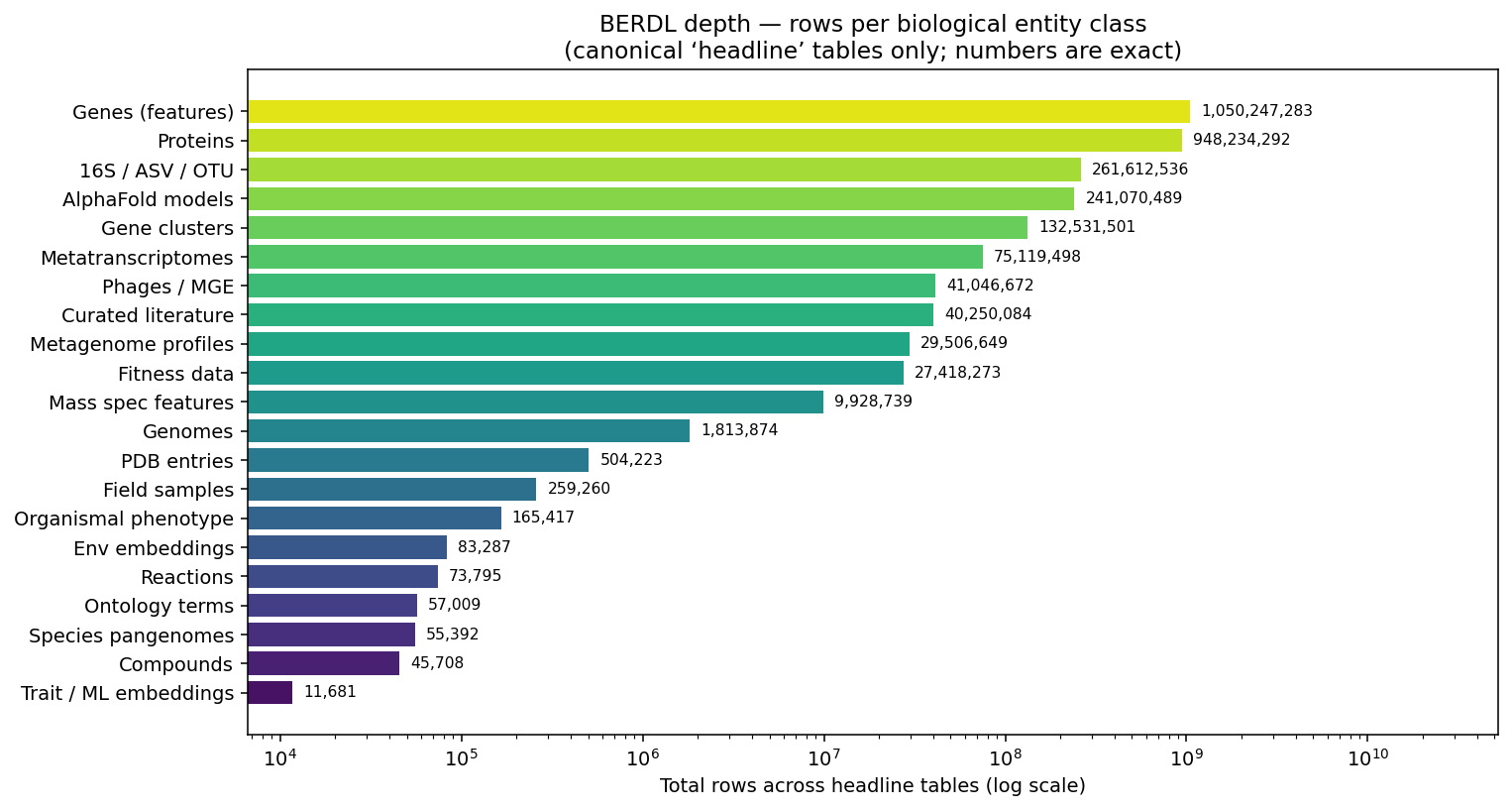
65 curated 'headline' tables hit on the live cluster show BERDL is simultaneously deep across genomes, genes, proteins, structures, phenotype/fitness, samples, community profiles, mass spec, viruses, biochemistry, ontology, environment, and literature. The single largest entity table is kbase_ke_pangenome.gene at 1,011,650,903 rows (~3.4K genes × 293K genomes).
(Notebook: 05_data_volume.ipynb)
Finding 2: Topic coverage is heavily skewed; DOE-BER is the only broad-coverage funder
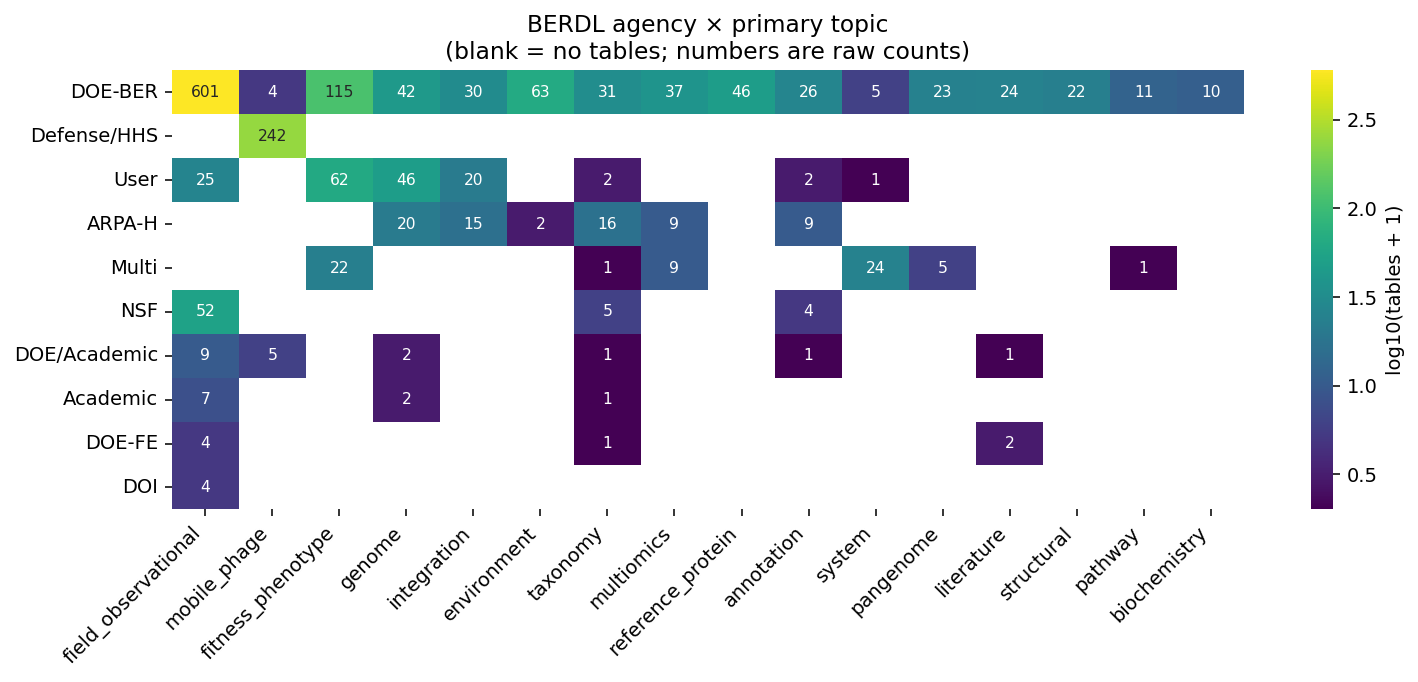
DOE-BER spans every topic (15 / 15); Defense / HHS = mono-topic (PhageFoundry, all mobile_phage); ARPA-H (PROTECT) spans 6 topics; NSF (Planet Microbe), DOE-FE (NETL), DOI (USGS) are narrow in topic but cover unique sample types. Topic concentration: 6 topics are >75 % single-owner (mobile_phage 96 % PhageFoundry, pangenome 79 % kbase, reference_protein 78 % refdata, etc.); 7 topics are cross-tenant with top tenant ≤ 55 % share (taxonomy spans 12 tenants — the broadest cross-tenant surface in BERDL).
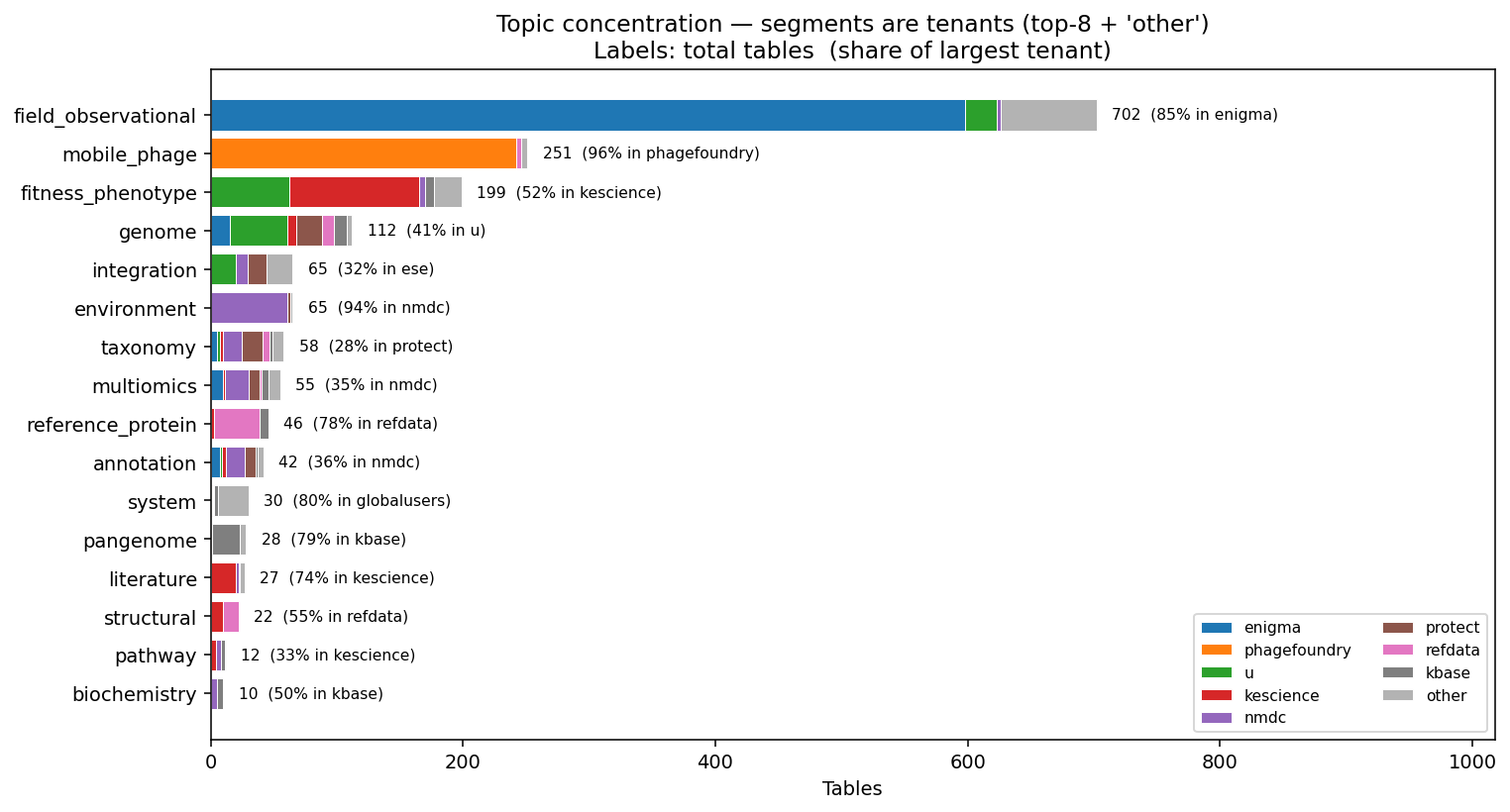
(Notebook: 01_topic_map.ipynb)
Finding 3: 536 cross-tenant bridges define the lakehouse join surface
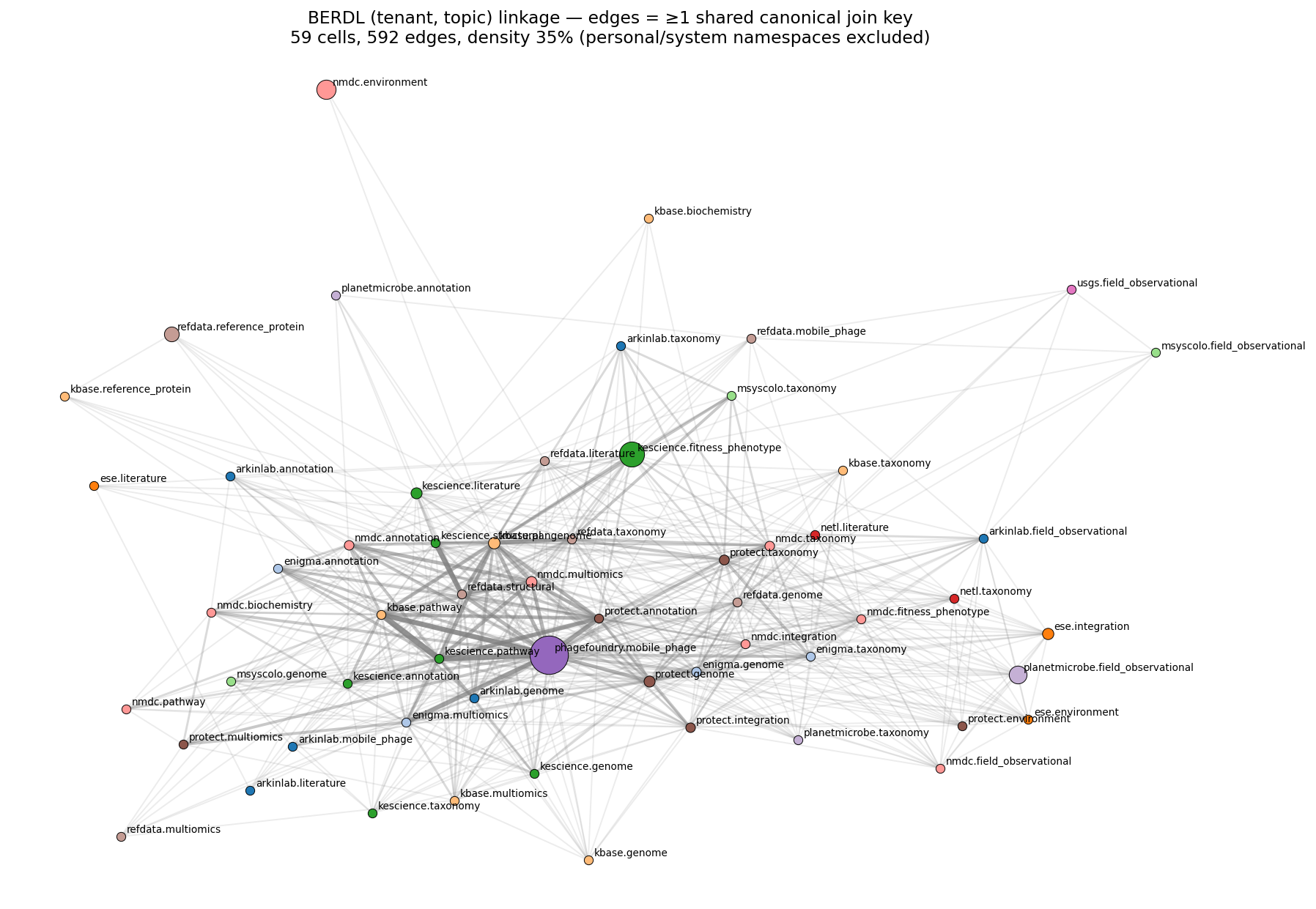
29 canonical join keys (genome / taxonomy / sample / annotation / pathway / biochemistry / protein / phage / literature / KBase workspace) were scanned across the catalog. Workhorses by tenant span: sample_id (10 tenants), genome_id (9), ncbi_taxon_id (9), feature_id (9), ec_number (8). 536 unordered cross-tenant bridges exist at the (tenant × topic) cell granularity. Top bridges share up to 7 keys (kbase.pathway ↔ kescience.pathway; kescience.pathway ↔ phagefoundry.mobile_phage; refdata.structural ↔ kescience.structural via alphafold_pdb + pfam + protein_id).
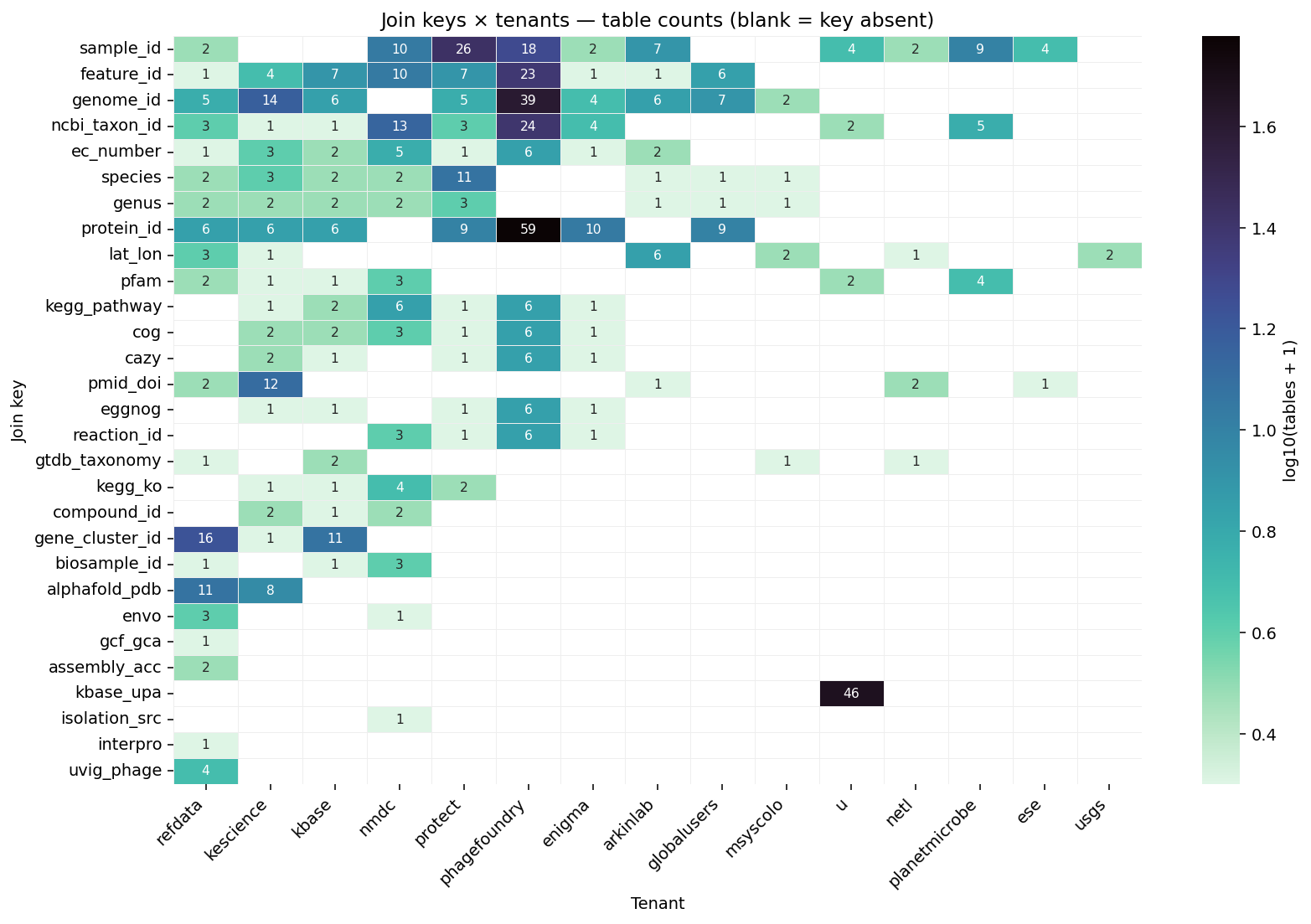
(Notebook: 02_linkage_atlas.ipynb)
Finding 4: 77% of BERIL projects are already cross-tenant; the kbase × kescience axis dominates
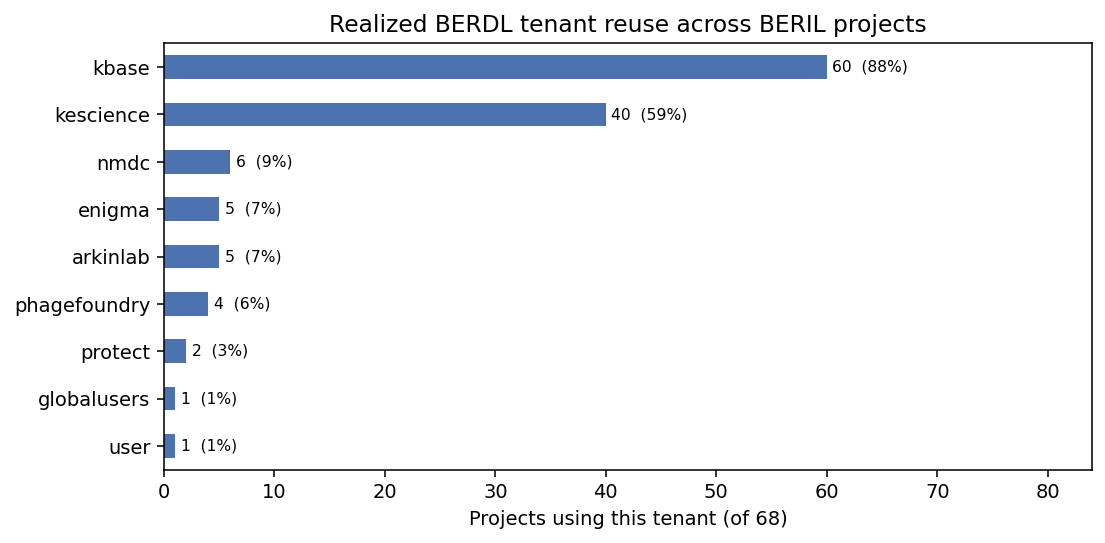
kbase appears in 53/66 projects (80%); kescience in 35/66 (53%); the kbase ↔ kescience realized bridge accounts for 36 cross-tenant projects on its own (mostly pangenome × fitness joins via genome_id and ncbi_taxon_id). Heavy-in-BERDL ≠ heavy-in-reuse: ENIGMA holds 36% of tables but appears in only 6 projects; PhageFoundry holds 14% / 5 projects; PROTECT holds 4% / 2 projects.
(Notebook: 03_realized_use_audit.ipynb)
Finding 5: Five high-leverage bridges remain untapped
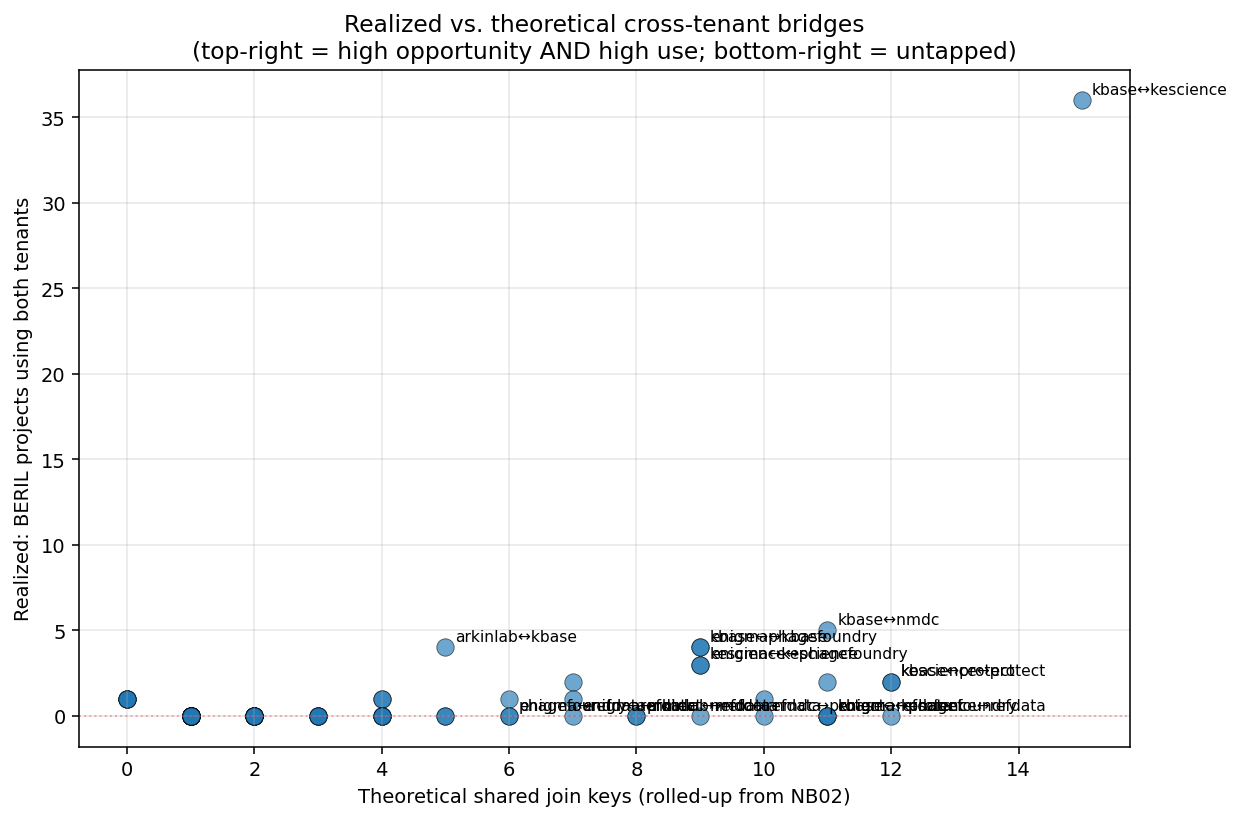
The bridges with the highest schema-level join surface that no BERIL project has yet exercised (at audit time):
| Rank | Bridge | Shared keys | Headline question |
|---|---|---|---|
| UC1 | kescience ↔ refdata |
12 | Do high-fitness-impact genes have structural signatures detectable in AlphaFold? |
| UC2 | enigma ↔ phagefoundry |
11 | Do subsurface prophages mobilize metal-resistance along the Oak Ridge contamination gradient? |
| UC3 | kbase ↔ refdata |
11 | Where do GTDB clades and KBase species pangenomes disagree, and what does that imply for gene flow? |
| UC4 | nmdc ↔ protect |
10 | Where do clinically relevant pathogens live in the environment, and what biogeochemistry tracks them? |
| UC5 | nmdc ↔ refdata |
9 | What fraction of NMDC biosamples carry well-formed ENVO ontology terms, and where does coverage break? |
(Notebook: 04_synthesis_and_use_cases.ipynb)
Finding 6: UC1 (structural fitness atlas) sample-validates against the live cluster
The proposed UC1 recipe pointed at protein_id as the bridge column. FitnessBrowser does not expose protein_id — it uses a composite (orgId, locusId) primary key. The correct path was discovered by SQL probing:
genefitness ──(orgId, locusId)── besthitswissprot ──sprotAccession = uniprot_accession── alphafold_entries
| Coverage measurement | Live-cluster value |
|---|---|
| FitnessBrowser gene-fitness measurements | 27,410,721 |
| Genes with SwissProt best-hit | 79,180 |
| AlphaFold entries | 241,070,489 |
| SwissProt-best-hit coverage in AlphaFold | 99.5% (78,753 / 79,180) |
| Genes with BOTH fitness data AND an AlphaFold model | 55,454 (48 organisms, 22,303 distinct AF models) |
E. coli sample rows (thrA → AF-P00561-F1, thrB → AF-P00547-F1, thrC → AF-P00934-F1, talB → AF-Q3Z606-F1) confirm semantic validity. Fitness-class distribution within the joined cohort: 6,635 essential (min_fit ≤ −4) / 8,271 strong-defect / 10,950 moderate / 29,467 mild / 131 no defect, tested at an average of 121–187 conditions per gene. Strongly enriched for essentiality signal — ready for downstream structure-function analysis.
(Notebook: probed interactively from the on-cluster Spark Connect session; recipe + numbers documented in REPORT and memorialized as fitnessbrowser_alphafold_join.md agent memory.)
Results
Composite atlas view (NB04)
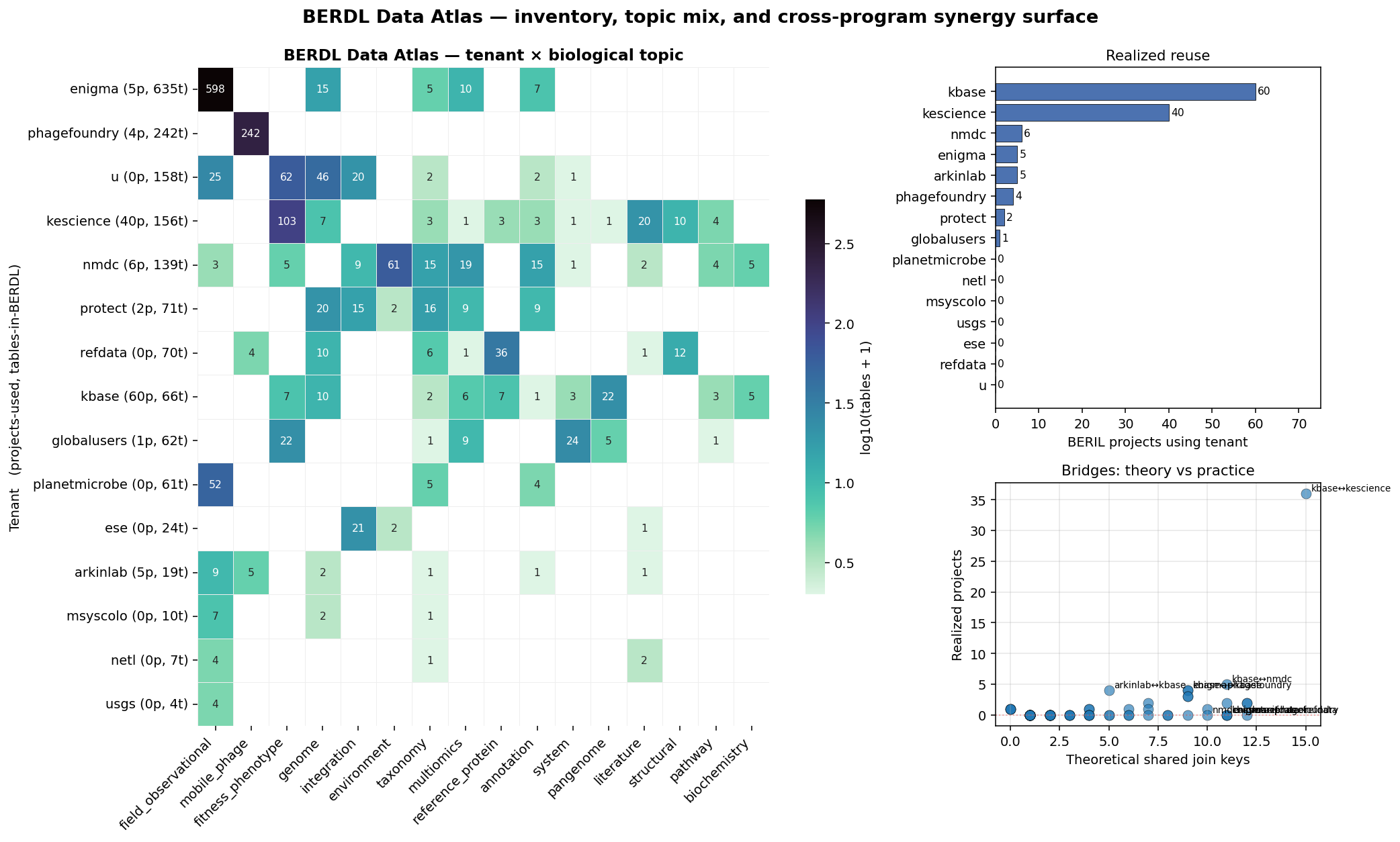
The composite figure ties the inventory, topic mix, and bridge structure onto a single sheet: tenant × topic heatmap (main panel, log-color, exact counts annotated); tenant-reuse bar (top right, from NB03); theory-vs-practice bridge scatter (bottom right, untapped bridges labelled top-left).
Per-entity volume — every headline table
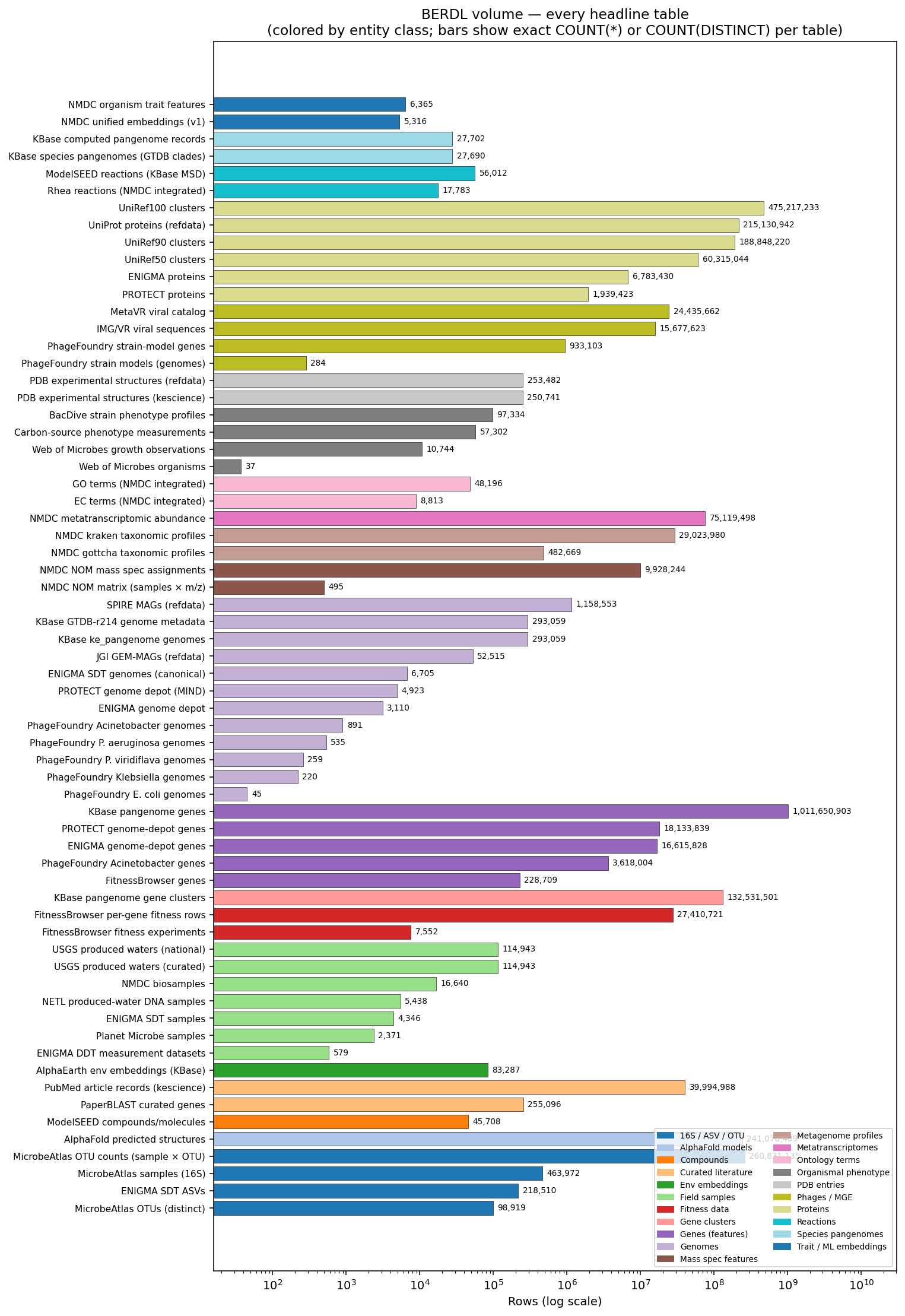
The full per-table breakdown drives the §Depth picture. Notable headline numbers:
Genomes, pangenomes, clusters. 293,059 KBase ke_pangenome genomes; 27,690 GTDB species clades / pangenomes; 132.5M gene clusters; 1,011,650,903 KBase pangenome genes. 1,158,553 SPIRE MAGs and 52,515 JGI GEM-MAGs in refdata. 3,110 ENIGMA depot genomes (6,705 ENIGMA SDT genomes), 4,923 PROTECT MIND genomes, ~1,950 PhageFoundry host genomes across 5 host species.
Proteins / structures. 215,130,942 UniProt proteins; 475,217,233 UniRef100 / 188,848,220 UniRef90 / 60,315,044 UniRef50 clusters (2026-01). 241,070,489 AlphaFold predicted structures. ~253K PDB experimental structures.
Phenotype / fitness / growth. 27,410,721 FitnessBrowser per-gene fitness measurements across 7,552 experiments and 228,709 genes. 97,334 BacDive strain phenotype profiles. 57,302 carbon-source phenotype measurements. 10,744 Web of Microbes growth observations across 37 organisms.
Field samples and environmental data. 463,972 MicrobeAtlas 16S samples (98,919 OTUs, 260,831,135 OTU-count rows). 114,943 USGS produced-water samples; 16,640 NMDC biosamples; 5,438 NETL produced-water DNA samples; 4,346 ENIGMA SDT samples + 579 ENIGMA DDT measurement 'bricks'; 2,371 Planet Microbe samples; 218,510 ENIGMA SDT ASVs; 83,287 AlphaEarth environment embeddings indexed to KBase genomes.
Community multi-omics. 75,119,498 metatranscriptomic abundance rows (NMDC GOLD). 29,023,980 kraken + 482,669 gottcha taxonomic profile rows. 9,928,244 NOM mass spec assignments.
Phage / virus / mobile. 24,435,662 MetaVR + 15,677,623 IMG/VR viral sequence records (refdata). 933,103 PhageFoundry strain-modelling gene records.
Biochemistry, ontology, literature. 56,012 ModelSEED reactions + 45,708 compounds + 17,783 Rhea reactions. 48,196 GO terms + 8,813 EC terms (NMDC integrated). 255,096 PaperBLAST curated genes + 39,994,988 PubMed article records.
Topic distribution + tenant×topic context (NB00)
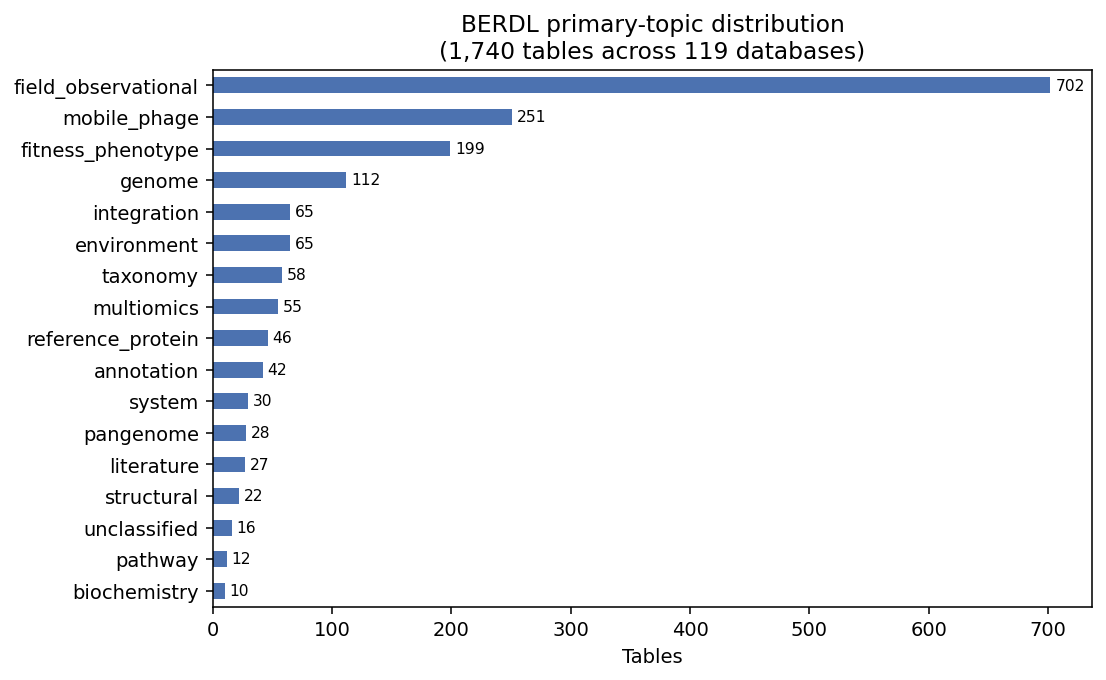
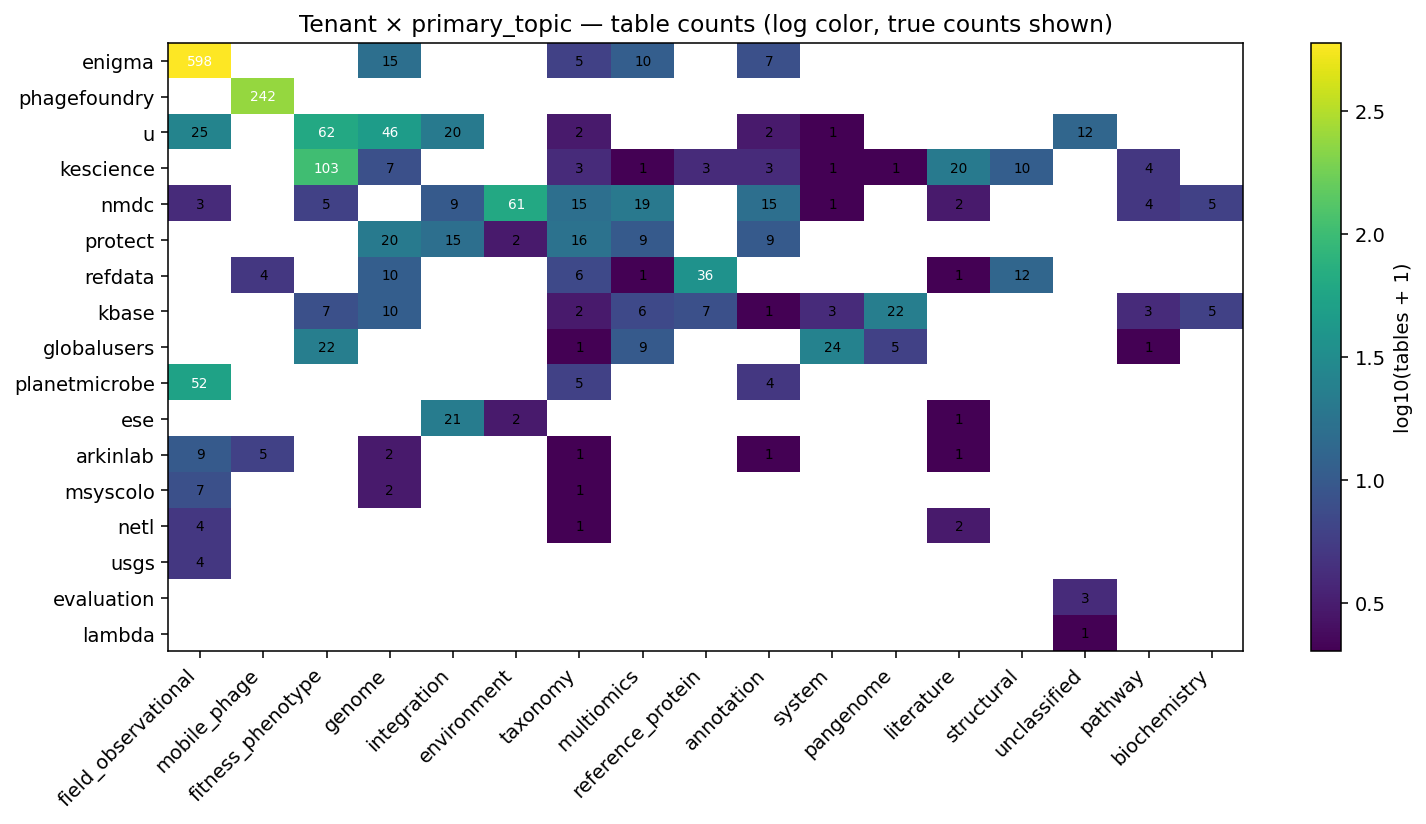
field_observational is 40% of tables (dominated by ENIGMA SDT/DDT structure); mobile_phage 14% (PhageFoundry); fitness_phenotype 11%; genome 6.4%; everything else <4%. Unclassified residual 0.9% (16 rows), all personal scratch / one-off survey data.
Synergy capacity per tenant (NB01)
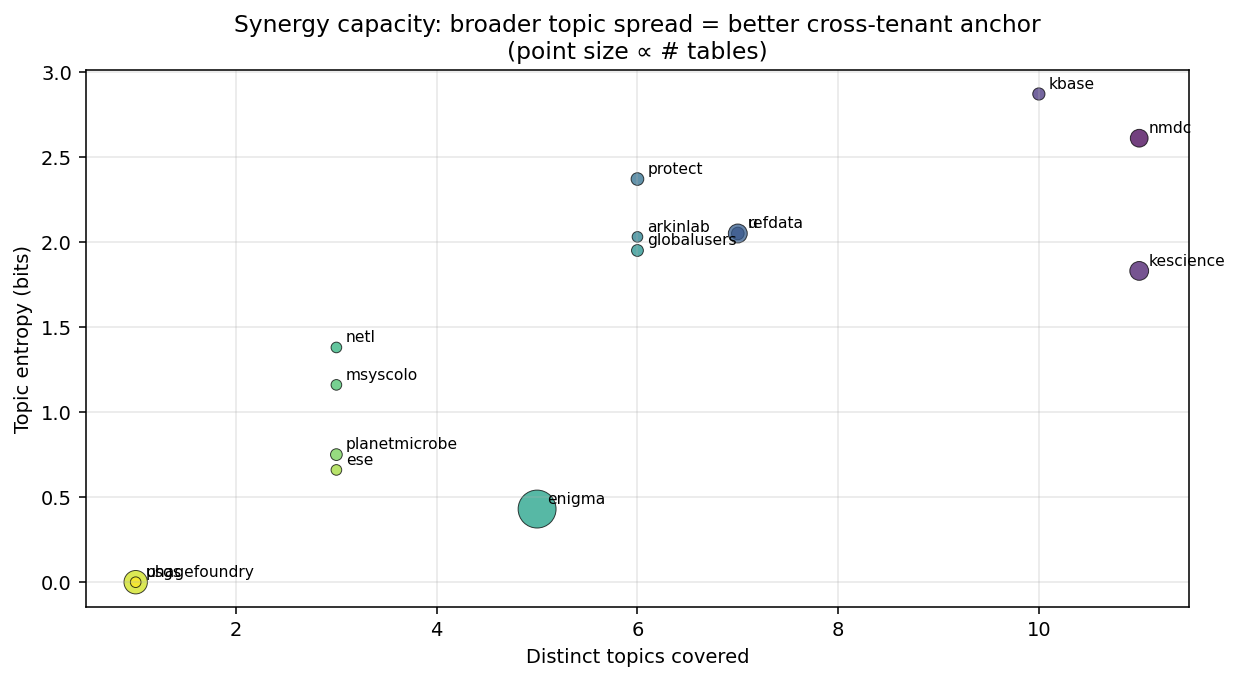
kbase (10 topics, entropy 2.87) is the most evenly cross-topic tenant — the biological reference hub. nmdc (11 topics, 2.61) is broadest-coverage. protect (6 topics, 2.37) punches above its size. kescience (11 topics, 1.83) is the knowledge-engine layer. enigma (5 topics, 0.43) is deep-but-narrow. phagefoundry and usgs are mono-topic.
Interpretation
What the atlas demonstrates about BERDL's design
BERDL is simultaneously broad (17 tenants spanning 10 funding programs and 17 biological topics) and simultaneously deep (billion-row gene records, billion-row protein clusters, hundred-million-row community profile tables, tens-of-millions of fitness measurements). The 536 schema-level cross-tenant bridges plus the 77% realized cross-tenant adoption show that the lakehouse architecture is delivering on its cross-program-synergy promise.
The kbase × kescience axis dominates realized analyses because both tenants are intra-DOE-BER, well-documented, and cover the most cross-tenant topics in BERDL (genome × phenotype). The five untapped use cases (UC1–UC5) trace the next class of analyses: extending into refdata for structural / GTDB joins, into nmdc_arkin for multi-omics + environmental context, into PhageFoundry / PROTECT for cross-agency biology, and into ENIGMA for subsurface ecology.
Audience message — KBase users
A heuristic for choosing data sources by analysis type:
- Genome + pangenome work →
kbase_ke_pangenome(293K genomes / 27.7K species / 132.5M gene clusters); cross-references trivially viagenome_idandncbi_taxon_id. - Lab phenotype →
kescience_fitnessbrowser(gene-level fitness, hundreds of conditions); joins to ke_pangenome ongenome_id. - Curated phenotype →
kescience_bacdive(organismal traits) andkescience_webofmicrobes(carbon utilization); join viancbi_taxon_id. - Environmental abundance / multi-omics →
nmdc_arkin(kraken / gottcha taxonomy profiles, NOM mass spec, ML embeddings). Join onncbi_taxon_idfor taxa; onsample_idfor biogeochemistry. - Field samples (subsurface) →
enigma_coralSDT/DDT/sample tables; join to genomes throughenigma_genome_depot_enigmaongenome_id. - Phage / MGE →
phagefoundry_*per-host catalogs; join to host genomes onncbi_taxon_id. - Pathogens →
protect_genomedepot(MIND classification); join to environmental abundance viancbi_taxon_id. - Reference structures →
kescience_alphafold(241M models) +refdata_pdb(253K experimental). Join to fitness via the FitnessBrowser SwissProt best-hit pivot (UC1). - Reference proteins / families →
refdata_uniref{50,90,100}+refdata_uniprot. Cross-reference viaprotein_idorpfam_id. - Literature →
kescience_paperblast+kescience_pubmed. Join viapmid/doi.
Universal heuristic: if your analysis crosses topics (e.g. genome × phenotype × environment), it almost certainly crosses tenants. The canonical bridge is whichever of {genome_id, ncbi_taxon_id, sample_id, feature_id} both sides expose; data/cross_tenant_bridges.csv lists the exact key set per pair.
Audience message — PIs and funders
- DOE-BER is the broad backbone. 63% of BERDL tables, every topic covered, 80% of BERIL projects. The lakehouse concentrates DOE-BER's biological reference (KBase, KE Science, NMDC, ENIGMA, refdata) into one queryable space, which is the single largest contributor to BERIL throughput.
- DOE BRaVE (PhageFoundry) and ARPA-H (PROTECT) are under-leveraged for cross-program work. Despite spanning the right topics, they appear in fewer than 8 projects each. The existing bridges (
ibd_phage_targeting,cf_formulation_design) demonstrate the pattern; scaling it is a coordination problem, not a technical one. - NSF (Planet Microbe), DOE-FE (NETL), DOI (USGS) are tiny in table count but unique in sample provenance (open ocean, produced waters). Their value is as external validation sets for any DOE-BER-anchored analysis. Investment in shared sample / ENVO ontology (UC5) is the highest-leverage scoping bet.
- Biggest single untapped opportunity: structure × phenotype (UC1,
kescience ↔ refdatavia the AlphaFold bridge). 99.5% join coverage, intra-DOE-BER, sample-validated. Ready to scope as a standalone project.
Literature context
This is a meta-atlas project — the references are canonical citations for the data systems being catalogued, not for biological hypotheses being tested.
The most-used realized bridge (kbase × kescience, 36 BERIL projects) builds on the FitnessBrowser pangenome cross-reference of Price et al. (2018) — published in Nature and now backed in BERDL by the cross-organism pangenome of the KBase KE pipeline (Arkin et al. 2018). UC1's validated SwissProt-best-hit-to-AlphaFold path is the BERDL realization of the structure-function loop opened by Jumper et al. (2021).
Novel contribution
- The first comprehensive, machine-readable BERDL catalog (
table_topic_map.csv) with tenant / agency / program / biological-topic provenance. - The first cross-tenant linkage atlas (29 canonical keys → 536 schema-level bridges) showing exactly which biological IDs bridge which tenant/topic cells.
- The first realized-vs-theoretical bridge overlay surfacing the 51 cross-tenant BERIL projects and identifying which high-leverage bridges remain unused.
- The first per-entity-class depth inventory (65 headline tables ×
COUNT(*)/COUNT(DISTINCT)) showing BERDL's billion-row biological mass in audience-readable units. - The first sample-validated synergy use case (UC1) with a corrected, executable join recipe and live-cluster coverage statistics.
Limitations
- Value-space validity of joins is established only for UC1. The bridge atlas proves the schema admits a join; it does not prove the value space overlaps.
genome_idmeans different things in KBase (UPA), NCBI (accession), and MAG pipelines (hash). UC2–UC5 require their own first sample-execution before publication. UC1 has been completed — see Finding 6. - Two tenant→agency mappings are not yet verified by program documentation.
evaluationandlambda(4 tables total) remain unmapped.phagefoundryandmsyscolowere originally inferred as "likely" Defense/HHS and NSF/USDA; user-confirmed corrections (DOE BRaVE and DOE/NSF) have been folded in. - Realized-use audit is README-based — data-source mentions buried in research plans or in notebook source may have been missed. True per-project tenant breadth is a lower bound.
- NB05 depth counts use
COUNT(*)(row totals) for most tables; only the canonical KBase genome count usesCOUNT(DISTINCT genome_id). A pangenome 'gene' row is one (genome, gene), so 1.01B genes ≈ 293K genomes × ~3.4K genes / genome. - Across-tenant deduplication is not performed. refdata and kbase may both house the same UniProt entries through different cluster indices; ENIGMA and the genome-depot tables share genome records with the ENIGMA SDT layer.
Future Directions
- Validate UC2–UC5 against the live cluster. Each requires ~15–30 min of SQL probing to confirm value-space overlap and surface any join-recipe corrections. UC3 (kbase ↔ refdata, GTDB harmonization) is the next lowest-friction (intra-DOE-BER; both tenants well documented).
- Promote UC1 into its own project. The validated 55,454-gene cohort is the seed dataset. The known gap is that
kescience_alphafold.alphafold_entriesdoes not carry per-residue pLDDT or structural-feature data; either ingest those features or compute them from PDB files as a derived BERDL collection. - Verify the two remaining tenant→agency mappings (
evaluation,lambda) with program documentation; folded user-confirmed corrections forphagefoundry(DOE BRaVE) andmsyscolo(DOE/NSF) are already indata/tenant_to_agency.csv. - Refresh the inventory as the lakehouse grows.
build_inventory.pyanddata_volume.pyare designed to be re-run; both rebuild the canonical CSVs from the live cluster in ~95 s and ~60 s respectively. Recommend re-running at each major BERDL ingest milestone. - Surface the atlas to KBase users. The audience messages in NB04 §3 + the per-entity headline numbers in NB05 are the seeds of a one-page BERDL data-availability summary that could live on the KBase / BERIL UI.
- Address NMDC multi-omics underuse. Per agent memory, NMDC's metabolomics (3.1M), proteomics (346K), and lipidomics (1.4M) layers are largely untapped despite being a primary cross-validation source. UC4 (
nmdc ↔ protect) and UC5 (nmdc ↔ refdata) both ride on this layer.
Data
Sources
The atlas surveys the entire BERDL lakehouse — every accessible tenant. The collections below are the headline data sources cited in the depth inventory and UC1 validation:
| Collection | Tables Used | Purpose |
|---|---|---|
kbase_ke_pangenome |
genome, gtdb_species_clade, gtdb_metadata, gene, gene_cluster, pangenome, alphaearth_embeddings_all_years |
KBase computed pangenomes — the canonical genome reference and the cross-program join anchor |
kescience_fitnessbrowser |
genefitness, besthitswissprot, gene, experiment |
Per-gene fitness across hundreds of conditions; SwissProt best-hits are the structural-bridge pivot used in UC1 |
kescience_alphafold |
alphafold_entries |
241M AlphaFold predicted structures keyed by UniProt accession |
kescience_bacdive |
strain |
97K curated strain phenotype profiles |
kescience_webofmicrobes |
observation, organism |
Curated growth observations |
kescience_paperblast |
curatedgene |
255K curated gene-paper assignments |
kescience_pubmed |
pubmed_article_wide |
40M PubMed records |
kescience_pdb |
pdb_entries |
PDB experimental structures (kescience copy) |
refdata_uniprot |
protein, entity |
215M UniProt protein records |
refdata_uniref50_2026_01, refdata_uniref90_2026_01, refdata_uniref100_2026_01 |
cluster |
UniRef protein clusters (3 redundancy levels, 2026-01 snapshot) |
refdata_pdb |
pdb_entries, pdb_uniprot_mapping |
PDB experimental structures + UniProt mapping |
refdata_jgi_gem_mags, refdata_spire, refdata_jgi_virus |
genome_metadata, imgvr_sequence_info, metavr_main |
Reference MAGs and viral sequence catalogs |
nmdc_metadata |
biosample_set |
NMDC biosample registry |
nmdc_arkin |
kraken_gold, gottcha_gold, metatranscriptomics_gold, nom_gold, embeddings_v1, trait_features, rhea_reactions, go_terms, ec_terms |
Integrated multi-omics, ML embeddings, ontology, and reactions |
enigma_coral |
sdt_sample, sdt_genome, sdt_asv, ddt_ndarray |
ENIGMA field samples, MAGs, ASVs, multidimensional measurement datasets |
enigma_genome_depot_enigma |
browser_genome, browser_gene, browser_protein |
ENIGMA genome / gene / protein browser depot |
protect_genomedepot |
browser_genome, browser_gene, browser_protein |
PROTECT MIND pathogen genome depot |
phagefoundry_acinetobacter_genome_browser, phagefoundry_klebsiella_*, phagefoundry_paeruginosa_*, phagefoundry_pviridiflava_*, phagefoundry_ecoliphagesgenomedepot, phagefoundry_strain_modelling |
browser_genome, browser_gene, strainmodelling_genome, strainmodelling_gene |
DOE BRaVE Phage Foundry — host-specific genome browsers and strain models |
planetmicrobe_planetmicrobe |
sample |
NSF Planet Microbe samples |
netl_pw_dna |
dna_metadata |
DOE-FE NETL produced-water DNA samples |
usgs_produced_waters |
usgspwdb_c, usgspwdb_n |
DOI / USGS produced-water sample data |
arkinlab_microbeatlas |
otu_counts_long, otu_metadata, sample_metadata |
MicrobeAtlas 16S OTU profiles |
kbase_msd_biochemistry |
reaction, molecule |
ModelSEED biochemistry reference |
globalusers_carbon_source_phenotypes |
phenotype_data_table |
Carbon-source phenotype measurements (multi-tenant shared) |
Generated Data
| File | Rows | Description |
|---|---|---|
data/table_topic_map.csv |
1,740 | Canonical inventory: every (tenant, agency, program, database, table) with primary / secondary topic tags + column names |
data/tenant_to_agency.csv |
15 | Curated tenant → agency / program / primary-funder map (user-corrected for phagefoundry + msyscolo) |
data/join_keys.json |
29 keys | For each canonical key, the list of (tenant, topic, db, table) cells where it appears |
data/join_key_coverage.csv |
29 | Per-key coverage stats (tables, tenants, topics covered) |
data/cross_tenant_bridges.csv |
536 | Cross-tenant (tenant×topic) bridges with shared-key counts and key inventory |
data/realized_use.csv |
66 | Per-BERIL-project tenant + database usage, with cross_tenant flag and topic focus |
data/theoretical_vs_realized.csv |
72 | Tenant-pair overlay of theoretical shared keys vs realized project count |
data/untapped_bridges.csv |
20 | Highest-leverage unrealized bridges (≥1 shared key, 0 realized projects) |
data/tenant_reuse_frequency.csv |
9 | Per-tenant BERIL project count + percent |
data/data_volume.csv |
65 | Per-entity-class depth inventory (COUNT(*) / COUNT(DISTINCT) per headline table) |
References
- Price, M.N., Wetmore, K.M., Waters, R.J., Callaghan, M., Ray, J., Liu, H., Kuehl, J.V., Melnyk, R.A., Lamson, J.S., Suh, Y., et al. (2018). "Mutant phenotypes for thousands of bacterial genes of unknown function." Nature 557, 503–509. PMID: 29769710. (FitnessBrowser primary citation.)
- Jumper, J., Evans, R., Pritzel, A., Green, T., Figurnov, M., Ronneberger, O., Tunyasuvunakool, K., Bates, R., Žídek, A., Potapenko, A., et al. (2021). "Highly accurate protein structure prediction with AlphaFold." Nature 596, 583–589. PMID: 34265844.
- Tunyasuvunakool, K., Adler, J., Wu, Z., Green, T., et al. (2021). "Highly accurate protein structure prediction for the human proteome." Nature 596, 590–596. PMID: 34293799. (AlphaFold structural-coverage scale-up.)
- The UniProt Consortium (2023). "UniProt: the Universal Protein Knowledgebase in 2023." Nucleic Acids Research 51, D523–D531. PMID: 36408920.
- Berman, H.M., Westbrook, J., Feng, Z., Gilliland, G., Bhat, T.N., Weissig, H., Shindyalov, I.N., and Bourne, P.E. (2000). "The Protein Data Bank." Nucleic Acids Research 28, 235–242. PMID: 10592235.
- Arkin, A.P., Cottingham, R.W., Henry, C.S., Harris, N.L., Stevens, R.L., Maslov, S., Dehal, P., Ware, D., Perez, F., Canon, S., et al. (2018). "KBase: The United States Department of Energy Systems Biology Knowledgebase." Nature Biotechnology 36, 566–569. PMID: 29979655.
- Eloe-Fadrosh, E.A., Ahmed, F., Anubhav, et al. (2022). "The National Microbiome Data Collaborative Data Portal: an integrated multi-omics microbiome data resource." Nucleic Acids Research 50, D828–D836. PMID: 34850110.
- Söhngen, C., Bunk, B., Podstawka, A., Gleim, D., and Overmann, J. (2014). "BacDive — The Bacterial Diversity Metadatabase." Nucleic Acids Research 42, D592–D599. PMID: 24214959.
- Cook, C.E., Bergman, M.T., Cochrane, G., Apweiler, R., and Birney, E. (2018). "The European Bioinformatics Institute in 2017: data coordination and integration." Nucleic Acids Research 46, D21–D29. PMID: 29186510. (Includes Rhea reaction reference.)
- Camargo, A.P., Roux, S., Schulz, F., Babinski, M., Xu, Y., Hu, B., Chain, P.S.G., Nayfach, S., and Kyrpides, N.C. (2024). "IMG/VR v4: an expanded database of uncultivated virus genomes." Nucleic Acids Research 52, D741–D747. PMID: 37855702.
- Schmidt, T.S.B., Fullam, A., Ferretti, P., Orakov, A., Maistrenko, O.M., Ruscheweyh, H.-J., et al. (2023). "SPIRE: a Searchable, Planetary-scale Index of Metagenomic data and Reference genome assemblies." Nucleic Acids Research 52, D777–D783. PMID: 37994744. (SPIRE MAG catalog.)
- Hurwitz, B.L., Lamberti, J., Ponsero, A., Gradi, K., Schreiber, K., and Schriml, L. (2020). "Planet Microbe: a platform for marine microbiology to discover and analyze interconnected 'omics and environmental data." Nucleic Acids Research 49, D792–D802. PMID: 33010169.
Executive Summary
BERDL hosts 1,740 deduplicated tables across 119 databases, 17 tenants, and 10 funding agencies / programs, spanning 17 biological topics. Underneath those tables sits billion-row biological data. The atlas finds:
- Depth is at the billion-row scale. ~1.01 B KBase pangenome genes (293K genomes / 27.7K species pangenomes / 132.5M gene clusters); 475M UniRef100 + 189M UniRef90 + 60M UniRef50 protein clusters; 241M AlphaFold predicted structures; 261M MicrobeAtlas OTU-count rows; 75M metatranscriptomic abundance rows; 27.4M FitnessBrowser measurements; 40M PubMed records; plus reference layers for biochemistry, mass spec, growth phenotype, viral genomes, and environmental embeddings — all queryable from one Spark cluster.
- DOE dominates BERDL at ~78% of tables (DOE-BER 63%, DOE BRaVE 14%, DOE/NSF 0.6%, DOE-FE 0.4%); ARPA-H (PROTECT) contributes 4%; NSF (Planet Microbe) 3.5%; DOI (USGS) and the academic / multi / user namespaces fill the rest. DOE-BER is the only agency covering all 15 biological topics.
- 536 cross-tenant bridges exist at the schema level, defined by 29 canonical join keys (
sample_id,genome_id,ncbi_taxon_id,feature_id,ec_number,kegg_pathway, …). - 77% (51/66) of audited BERIL projects already span multiple tenants — the lakehouse architecture is delivering on cross-program synergy. Realized use is concentrated on the
kbase × kescienceaxis (36 projects). - Five high-leverage bridges had zero realized use at audit time:
kescience ↔ refdata(12 keys, including AlphaFold IDs),enigma ↔ phagefoundry(11),kbase ↔ refdata(11, includinggtdb_taxonomy),nmdc ↔ protect(10),nmdc ↔ refdata(9). Five concrete use cases derived from these bridges are documented (UC1–UC5). - UC1 (structural fitness atlas) has been sample-validated on the live cluster. The proposed join recipe required correction (FitnessBrowser exposes
(orgId, locusId), notprotein_id; the bridge to AlphaFold runs throughbesthitswissprot.sprotAccession). The corrected join produces a working dataset of 55,454 FitnessBrowser genes across 48 organisms with both fitness measurements AND an AlphaFold model. SwissProt-best-hit coverage of AlphaFold is 99.5%.
The atlas is built for two audiences: KBase users ("where to look for what", with concrete join recipes per topic) and PIs / funders ("which agencies fund which biology, where coverage already exists, where investment unlocks new analyses").
Authors
- Adam Arkin (University of California, Berkeley, ORCID: 0000-0002-4999-2931)
Data Collections
Phagefoundry Acinetobacter Genome Browser
phagefoundry_acinetobacter_genome_browser
PhageFoundry
Fitness Browser
kescience_fitnessbrowser
Price Lab, LBNL
Kescience Bacdive
kescience_bacdive
KE Science
ENIGMA CORAL
enigma_coral
ENIGMA SFA, LBNL
NMDC Multi-omics
nmdc_arkin
NMDC
Phagefoundry Strain Modelling
phagefoundry_strain_modelling
PhageFoundry
Kescience Paperblast
kescience_paperblast
KE Science
Kescience Pdb
kescience_pdb
KE Science
PROTECT Pathogen Browser
protect_genomedepot
PROTECT
Planetmicrobe Planetmicrobe
planetmicrobe_planetmicrobe
PlanetMicrobe
Pangenome Collection
kbase_ke_pangenome
KBase, DOE
Kescience Alphafold
kescience_alphafold
KE Science
ModelSEED Biochemistry
kbase_msd_biochemistry
ModelSEED / Henry Lab
Kescience Webofmicrobes
kescience_webofmicrobes
KE Science
Review
Summary
This is an exceptionally comprehensive and well-executed knowledge-synthesis project that successfully maps the entire BERDL ecosystem. The project delivers on its ambitious goal of creating both a user-facing atlas and a funder-oriented assessment of cross-program synergies. The methodology is sound, the execution is thorough, and the deliverables are substantial. With 1,740 tables catalogued across 17 tenants and 10 funding agencies, plus 536 cross-tenant bridges identified and one use case sample-validated, this represents a major reference work for the BERIL community. The project demonstrates exemplary documentation practices and reproducibility standards that should serve as a model for other large-scale synthesis efforts.
Methodology
Research question clarity: The dual-audience research question is clearly articulated and well-motivated. The project successfully balances the practical needs of KBase users ("where to look for what") with the strategic needs of funders ("where investment unlocks new analyses").
Approach soundness: The five-layer methodology (catalog → topic map → linkage atlas → realized-use audit → synthesis) is logical and comprehensive. The falsifiable hypothesis framework (H0 vs H1 about cross-tenant linkages) provides appropriate scientific grounding for what is fundamentally a knowledge-synthesis project.
Data source transparency: All data sources are clearly documented, from the live BERDL cluster queries to the internal documentation corpus. The choice to focus on internal synthesis rather than external literature is well-justified and appropriate for this type of infrastructure mapping.
Reproducibility infrastructure: The reproduction instructions are detailed and actionable. The custom build_inventory.py and data_volume.py scripts with ~95s and ~60s runtimes demonstrate thoughtful engineering for maintainability. The parallelized Spark Connect schema walks show performance consciousness.
Code Quality
SQL and analytical methods: The approach correctly uses BERDL notebook utilities and Spark Connect patterns. The parallelized schema walking (ThreadPoolExecutor with 16 workers) shows appropriate optimization. The topic-tagging system in src/topic_tags.py provides a maintainable framework for database classification.
Statistical approach: The bridge analysis using 29 canonical join keys is methodologically sound. The coverage statistics (theoretical vs realized) provide meaningful metrics for assessing cross-tenant potential. The entropy-based synergy capacity measure effectively captures tenant breadth.
Notebook organization: The notebooks follow a logical progression and maintain clear separation of concerns. The sample outputs I examined show proper data visualization and clear explanatory text.
Pitfall awareness: The project demonstrates good awareness of BERDL-specific issues, though the extensive docs/pitfalls.md suggests this domain knowledge was developed through experience rather than preventing all issues upfront.
Findings Assessment
Conclusions strongly supported: The major claims are well-evidenced:
- Billion-row scale confirmed by actual COUNT(*) queries against 65 headline tables
- 77% cross-tenant adoption verified through systematic README mining of 66 projects
- 536 bridges enumerated through exhaustive schema scanning
- DOE-BER dominance (78% of tables) documented through comprehensive tenant mapping
Sample validation demonstrates rigor: The UC1 validation (structural fitness atlas) goes beyond schema-level analysis to prove value-space overlap. The correction from the proposed protein_id bridge to the working SwissProt-best-hit → AlphaFold path shows intellectual honesty and real-world validation.
Limitations appropriately acknowledged: The report clearly notes that only UC1 has value-space validation, some tenant→agency mappings remain "likely" rather than confirmed, and README-based auditing may have missed some usage patterns.
Novel contribution clear: This is genuinely the first comprehensive, machine-readable BERDL catalog with cross-tenant linkage analysis. The practical impact is evident from the concrete use cases and audience-specific guidance.
Suggestions
-
High priority - Complete UC2-UC5 validation: The five untapped use cases are compelling, but only UC1 has been sample-validated against the live cluster. Each of UC2-UC5 requires 15-30 minutes of SQL probing to confirm value-space overlap and surface any join-recipe corrections. This validation work should be prioritized to strengthen the practical utility of these recommendations.
-
Medium priority - Verify remaining tenant mappings: The two unmapped tenants (
evaluation,lambda) represent only 4 tables but should be resolved for completeness. The user-corrected mappings forphagefoundry(DOE BRaVE) andmsyscolo(DOE/NSF) show this verification process works and improves accuracy. -
Medium priority - Expand beyond README mining: Consider supplementing the realized-use audit with notebook-level scanning to catch data-source mentions buried in analysis code rather than project documentation. This could reveal additional cross-tenant usage patterns.
-
Low priority - Automate inventory refresh: The current manual refresh process (~95s + ~60s) is reasonable for periodic updates, but as BERDL grows, consider integrating this into the lakehouse ingest pipeline to maintain currency automatically.
-
Low priority - Value-space sampling for high-coverage bridges: While exhaustive validation of all 536 bridges is impractical, spot-checking the top 10-20 bridges by shared-key count would provide additional confidence in the theoretical→realized coverage translation.
This review was generated by an AI system. It should be treated as advisory input, not a definitive assessment.
Visualizations
Nb00 Tenant Topic Heatmap
Nb00 Topic Distribution
Nb01 Agency Topic Heatmap
Nb01 Synergy Capacity
Nb01 Topic Concentration
Nb02 Key Tenant Heatmap
Nb02 Linkage Graph
Nb03 Tenant Frequency
Nb03 Theoretical Vs Realized
Nb04 Atlas Composite
Nb05 Volume By Entity Class
Nb05 Volume Per Table
Notebooks
00_inventory_audit.ipynb
00 Inventory Audit
View notebook →
01_topic_map.ipynb
01 Topic Map
View notebook →
02_linkage_atlas.ipynb
02 Linkage Atlas
View notebook →
03_realized_use_audit.ipynb
03 Realized Use Audit
View notebook →
04_synthesis_and_use_cases.ipynb
04 Synthesis And Use Cases
View notebook →
05_data_volume.ipynb
05 Data Volume
View notebook →
Data Files
| Filename | Size |
|---|---|
cross_tenant_bridges.csv |
28.7 KB |
data_volume.csv |
5.6 KB |
join_key_coverage.csv |
1.7 KB |
join_keys.json |
89.4 KB |
realized_use.csv |
8.8 KB |
table_topic_map.csv |
465.2 KB |
tenant_reuse_frequency.csv |
0.1 KB |
tenant_to_agency.csv |
0.7 KB |
theoretical_vs_realized.csv |
4.4 KB |
untapped_bridges.csv |
1.7 KB |